
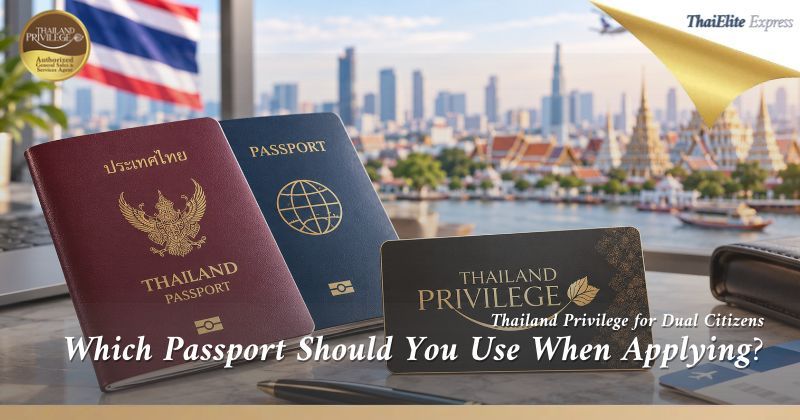
If you hold two nationalities, choosing the correct passport for a Thailand Privilege application can feel complicated. You may use one passport for airline bookings, another for entering Thailand, and have previous Thai visa or immigration records connected to a different document.
The practical answer is that there is no universal rule requiring every dual national to use one particular passport. However, consistency is important. The passport recorded in your Thailand Privilege application should be clearly identified, valid, and coordinated with the passport you intend to use for the relevant immigration process.
Before submitting your application, confirm how your passport choice will affect:
If your situation involves two nationalities, different spellings of your name, multiple passports, or previous Thai visas, obtain case-specific confirmation before submitting final documents.
A passport is not only an identity document. It also connects your identity to travel, immigration, and visa records.
When applying for Thailand Privilege, differences between passports or existing records may create avoidable questions. For example:
These situations do not automatically make a dual national ineligible. They mean that the documents should be disclosed, explained, and coordinated properly.
The objective is to create a clear record showing:
For current programme information, consult the Thailand Privilege programme information published by the official operator. Individual passport questions should still be confirmed for your specific circumstances.
Before preparing your Thailand Privilege application, gather information about both passports and your travel history.
Prepare the following details for each current passport:
A current, valid passport will generally be required for an application. However, do not assume that the passport with the longest validity is automatically the correct document for every stage. Your choice may also depend on your intended travel and immigration arrangements.
Review your recent travel pattern:
Your answer may be different for each question. That is why the passport-selection decision should be made before you submit the application.
Compare the following information in both passports:
Small differences do not necessarily prevent an application. However, they should be disclosed and supported with documentation when necessary. Supporting documents may include a marriage certificate, naturalisation certificate, birth certificate, or legal name-change document.
Tell your adviser if you have previously held or used:
This information can help determine whether a record update or clarification is needed before the Thailand Privilege application is finalised.
Your nationality may affect whether you need a visa before travelling, whether you qualify for visa exemption, or which documents an airline requests.
For official information about Thai visa applications, consult the Thai e-Visa application system. This resource covers Thai visa applications generally and does not replace confirmation of Thailand Privilege-specific procedures.
Possibly, but the documents must be coordinated carefully.
Travelling with two passports in Thailand is not simply a matter of using whichever document is most convenient at each checkpoint. Airlines and immigration authorities may need to understand how the two documents relate to one traveller and one journey.
Airlines commonly require passenger details to correspond with the travel document used for check-in. If you book a flight using one passport but plan to present another at the airport, contact the airline before travelling and ask how the documents should be recorded.
A practical approach is to:
Airline procedures can differ. Do not rely solely on general advice from another traveller with a different nationality combination.
Thai immigration records entry and departure using the passport presented at the border. If your Thailand Privilege documentation is connected to a particular passport, ask in advance whether you should present that passport or carry supporting evidence linking your passports.
If you enter Thailand with one passport and later want to use another for departure or immigration services, request guidance before making the change. Switching documents without explaining the connection may create questions about your entry record or permission to stay.
For the application, identify the passport you intend to use as your principal application document. Provide details of any second passport where requested or where it may affect the assessment of your identity, nationality, or travel history.
Do not omit a second nationality if the application form or adviser asks about it. At the same time, providing details of both passports does not necessarily mean that you must use both passports for every future immigration transaction.
The important point is to establish a clear, documented plan.
A frequent source of confusion is treating entry rules and Thailand Privilege membership requirements as if they were the same thing. They are separate issues.
Your passport may determine:
These rules may change and may differ between your two nationalities. For official Thai visa policy and consular information, consult the visa and consular information provided by Thailand’s Ministry of Foreign Affairs.
Thailand Privilege is a long-stay membership programme with its own application, screening, payment, and immigration procedures. The programme may request a passport and supporting personal documents to assess your application and issue the relevant documentation.
The passport used for Thailand Privilege does not automatically determine every future travel rule connected to your other nationality. Conversely, qualifying for visa exemption with one passport does not necessarily answer how your Thailand Privilege membership should be recorded.
For this reason, dual nationals should ask two separate questions:
The answer may be the same passport, but it should not be assumed.
Differences should be addressed before submission rather than left for airline or immigration staff to resolve.
Common differences include:
Prepare a short explanation and supporting documents where relevant. These may include:
Do not submit conflicting information without an explanation. If an online form permits only one passport, ask whether the second passport should be uploaded separately, listed in an additional-information section, or provided to the adviser for review.
If your passport has recently been renewed, ask how the new number should be recorded and whether existing Thailand Privilege or immigration information must be updated.
If you hold dual citizenship or use two passports for travel, ask these questions before finalising your application:
Written confirmation is particularly useful if your circumstances involve recent naturalisation, a change of name, an expired passport containing Thai immigration records, or a previous visa issued under another nationality.
Passport selection is separate from package selection. Once your documentation position is clear, you can compare membership periods, fees, and benefits.
エリート Thailand Privilege membership pricing guide can help you review current package costs and validity periods. If you are comparing Thailand Privilege with other routes, read the guide to long-term stay options in Thailand.
Do not choose a membership solely because one passport appears easier to use for a single trip. Consider your longer-term plans, including:
Before submitting your application, confirm that you have:
The safest approach is not to assume that one passport is always correct. Instead, create a consistent document trail and obtain confirmation for your specific circumstances.
Holding two nationalities does not, by itself, establish a universal rule that you cannot apply. Your application must be assessed using the programme’s current requirements and your personal documentation.
Disclose both nationalities when requested and ask which passport should be used as the principal application document.
Use the passport that the programme or authorised adviser confirms should be recorded as your principal application passport.
The appropriate choice may depend on your intended travel, existing Thai immigration records, nationality-specific entry rules, and the documents you can provide. Do not assume that the passport with the longest validity is automatically the correct choice.
It may be possible in some circumstances, but obtain confirmation before travelling. The passport used for entry creates the relevant immigration record, while the Thailand Privilege application may be connected to another document.
Carry both passports and supporting evidence if advised, and ensure that the relationship between them is clear.
Not necessarily in every case. However, you should disclose your second nationality if the application asks for it or if it is relevant to your identity and travel history.
An adviser can confirm whether copies of both passports, previous passports, or additional nationality documents are required.
Explain the difference and provide supporting documents where appropriate. Differences may result from marriage, naturalisation, transliteration, or a legal name change.
Do not leave a material discrepancy unexplained, especially if your Thai immigration or travel records use another version of your name.
Ask how passport renewal must be reported and whether your Thailand Privilege or immigration records need to be updated.
Keep your old passport if it contains relevant Thai visas, stamps, or identification details. Carry it with your new passport when advised.
Dual citizenship does not automatically make a Thailand Privilege application difficult, but passport selection should be handled deliberately. The appropriate document depends on your records, travel plans, nationality-specific rules, and the programme’s current procedures.
ThaiElite Express can review your passport situation, identify potential documentation issues, and help you prepare a clearer application before submission. Contact ThaiElite Express for a complimentary consultation about your Thailand Privilege application passport and travel-document requirements.
Internal links used:
External sources used:
These sources provide general programme, visa, and policy information. Individual dual-nationality cases should be confirmed directly with the relevant authority or an authorised Thailand Privilege adviser.
If you hold two nationalities, choosing the correct passport for a Thailand Privilege application can feel complicated.
詳しくはこちらIf you already hold a Thai visa or have permission to stay in Thailand, you may be able to plan...
詳しくはこちらAlready in Thailand and considering Thailand Privilege? Learn how your current visa, permission to stay, application timing, and visa activation...
詳しくはこちらThai Elite Express is operated by HLG (Thailand) Co., Ltd., a duly licensed General Sales Agent of the Thai Elite program and Thailand Privilege Card Co., Ltd. since 2013.