
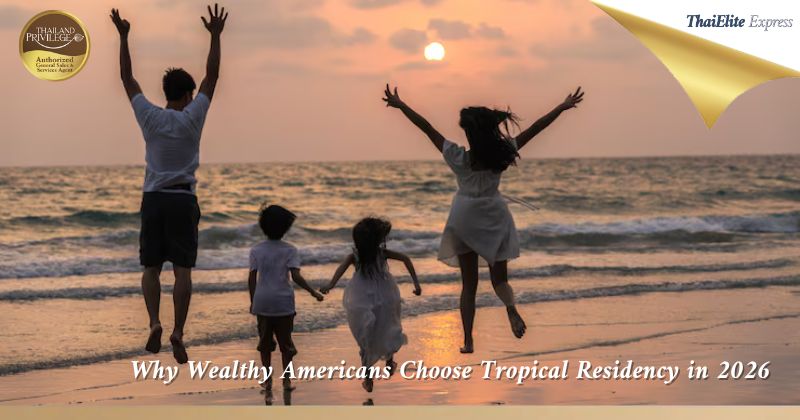
A decade ago, “retire abroad” was often framed as a cost-saving move—an exit from high U.S. expenses into a simpler, slower life. In 2026, something more strategic is happening. Affluent Americans are increasingly choosing Tropical Residency not as an escape, but as a designed lifestyle base—a way to trade financial and personal uncertainty for warmth, healthcare access, global mobility, and time sovereignty.
This isn’t about abandoning the United States. It’s about building options: living part-time or long-term in a place that supports your health, your work (if you still run a business), your freedom of movement, and your quality of life—without waiting for a traditional retirement “finish line.”
Tropical Residency is best understood as a modern lifestyle category: a long-term living strategy anchored in warm-climate destinations that offer a credible blend of:
Unlike “retiring abroad,” Tropical Residency is often adopted 前 traditional retirement. Many of the people planning it are still active: business owners, investors, consultants, remote executives, early retirees, and semi-retired couples who want the の前 to work and travel.
In other words: it’s not a place you go when life ends. It’s a place you choose to live well—now.
Affluent Americans don’t usually “run out of money” in retirement. The friction is different: the uncertainty of future costs, the complexity of systems, and the desire for a lifestyle that feels expansive rather than restricted.
The classic U.S. retirement plan assumes healthcare will be manageable. But planning assumptions have become more difficult.
Fidelity’s retiree health care cost estimate (as of April 2026) suggests an average retired couple may need roughly $345,000 (after tax) for healthcare costs in retirement—excluding long-term care. That number alone changes the emotional math for many households who can afford it but resent the lack of predictability.
When you can pay for excellent private care abroad at transparent prices—and still keep a U.S. “home base” option—Tropical Residency starts looking less like a leap and more like risk management.
Even among higher-income households, housing costs have become a bigger story: insurance, taxes, maintenance, and the rising cost of services.
Harvard’s Joint Center for Housing Studies reported that in 2023, 34% of older households were “cost burdened,” paying more than 30% of their income for housing. The point isn’t that wealthy Americans can’t afford housing—it’s that many no longer want their lifestyle to be anchored to a high fixed-cost structure.
Traditional retirement is built around stability: one home, one community, one system. Today’s affluent 45–70 cohort often wants flexibility:
Tropical Residency fits that model because it doesn’t require an identity shift into “retired.” It simply adds a second (or primary) base designed around how you actually want to live.
For affluent households, relocation is increasingly treated like a portfolio decision—diversification across:
This is one reason the trend is accelerating now. According to many Private Wealth Migration reports, cross-border relocation among millionaires is projected to rise to 165,000 in 2026 (up from 142,000 in 2025). The underlying theme is not only “tax” or “politics”—it’s the growing normalization of global mobility as a planning tool.
And affluent Americans often move earlier (45–60) because they have the resources to pilot locations, rent before buying, and build a long-range plan without urgency.
If you want this article to be useful (and not another glossy list of “best countries for retirement”), the decision framework matters more than the destination list.
Here’s what affluent Americans typically optimize for when planning long-term residency abroad:
Not just “good hospitals”—but:
Affluent households value rule clarity: what’s allowed, what’s enforced, and whether the system is navigable.
This is often the decisive factor. Two destinations may look equally attractive—until you compare:
Moving overseas from USA rarely eliminates complexity. U.S. citizens remain subject to U.S. tax rules, and cross-border living adds reporting considerations. The most successful Tropical Residency planners align early with qualified tax and legal professionals—before they fall in love with a location.
There is no single “best country for retirement” because most affluent Americans are not optimizing for price alone. They’re optimizing for lifestyle stability.
Below is a strategic comparison of leading warm-climate and tropical residency contenders.
Thailand offers a rare range: Bangkok for global-city living, Chiang Mai for slower pace, and islands/coastal destinations for resort-style daily life. It works for both full-time relocation and split-year living.
Thailand’s private healthcare ecosystem is one of its strongest advantages. As a concrete indicator of international orientation, Bumrungrad’s investor information notes over 643,000 international medical episodes in 2024—a scale that signals deep experience with foreign patients.
Bangkok is a major regional hub with modern conveniences—high-end condos, international schools, and a service culture that many Westerners find unusually livable.
Thailand’s appeal is not “cheap.” It’s high lifestyle-to-cost efficiency in housing, services, wellness, and private healthcare—especially for those coming from high-cost U.S. metros.
Like any country, Thailand varies by neighborhood and lifestyle. But for many affluent residents, daily life can feel more orderly and service-supported than expected—especially in established expat hubs.
Thailand stands out because of clear long-stay pathways, including membership-based options.
One notable pathway is the Thailand Privilege Card (formerly Thailand Elite), which provides multi-year long-stay permission tied to membership tiers (5–20+ years). The official membership comparison document lists fees and tier structures, including:
Costa Rica is often chosen for its outdoor living, eco-wellness culture, and slower pace. It tends to attract people who want nature as part of their daily routine.
Costa Rica has respected medical care, especially in main urban areas, and is well-known among North American retirees. As always, quality and convenience vary by region.
Infrastructure can feel less “big city polished” than some Asian hubs. That’s a feature for some—and a drawback for others.
Costa Rica can be less inexpensive than many first-time expats assume. The value is lifestyle and nature access, not necessarily a dramatic cost reduction in every category.
Costa Rica’s legal residency categories are well-established. Its migration law (Ley 8764) includes commonly referenced thresholds such as $1,000/month for Pensionado and $2,500/month for Rentista categories (verify current application practice and requirements).
Panama is often selected less for “tropical fantasy” and more for practicality: a regional hub feel, business and finance services, and a structured residency landscape.
Panama City offers strong private healthcare options; outside the capital, availability can vary.
Panama performs well as a hub: banking, services, and international travel access are major draws.
Panama’s “Friendly Nations” framework is frequently cited. Official decrees (including updates in 2021) describe pathways and requirements that can include real estate or deposit-based ties, often starting with provisional residence before permanent status.
Portugal isn’t tropical year-round, but it remains in the “international retirement” conversation because it offers European lifestyle appeal, perceived stability, and Schengen access.
Coastal Portugal can feel temperate and relaxed, with strong cultural amenities. It often appeals to Americans who want Europe as a long-term base.
Portugal has solid infrastructure and public systems, with private options in major areas.
Portugal’s popular programs have evolved. The “Mais Habitação” reforms (Law 56/2023) reshaped Golden Visa eligibility—especially real estate-based routes—making it essential for planners to treat Portugal as a changing policy environment, not a static one.
Mexico offers proximity to the U.S., cultural richness, and a wide range of climates—from beach towns to highland cities.
Private healthcare in major cities can be strong, and proximity to U.S. care remains a psychological advantage for many.
Mexico’s residency pathways often involve financial solvency requirements processed through consulates, and practice can vary by location. For example, a 2026 consular economic solvency document for temporary residency references an income threshold (in USD) that illustrates how structured—and sometimes high—these requirements can be.
Malaysia is often shortlisted for urban comfort (Kuala Lumpur), island access (Langkawi), and Penang’s lifestyle appeal.
Private healthcare is a major draw in cities, and Malaysia has long been considered a strong value market for medical services.
Malaysia’s MM2H framework has had notable rule changes. Official terms (as of July 22, 2024) outline requirements and conditions, including fixed deposit rules—an example of how program structure can shift over time.
In 2026, the lifestyle dream is easy. The administrative reality is what determines whether Tropical Residency becomes sustainable.
Affluent Americans increasingly choose destinations based on:
This is one reason membership-style programs have gained attention: they convert “immigration uncertainty” into a clearer lifestyle framework.
Thailand’s Thailand Privilege Card is an example of how residency certainty can influence decisions—not because it’s the only path, but because it offers a defined term structure that many affluent households find easier to integrate into long-range planning.
They keep a U.S. home base for family and continuity but spend 6–8 months each year in a tropical hub with strong private healthcare. Their goal isn’t to “save money”—it’s to reduce wait times, simplify routine care, and live in a climate that supports daily movement. They plan their residency so they’re not dependent on tourist entries.
He still runs a U.S. company, but the business no longer requires a daily physical presence. He chooses a tropical base with reliable internet, international flights, and a time zone that allows overlap with U.S. mornings. Residency matters because he can’t afford to lose weeks to visa runs and administrative resets.
She wants second residency options—not necessarily for tax reasons, but for mobility and contingency planning. She chooses a destination where legal pathways are structured and where a second base improves her ability to travel, manage health, and diversify lifestyle risk.
They’re not “retiring.” They’re designing a five-year chapter abroad: better weather, slower pace, and international exposure for their children. They evaluate international schools, healthcare, safety, and whether the residency pathway is stable enough to support a normal life (leasing, utilities, banking, and travel).
Tourist rules are for tourism. Sustainable Tropical Residency requires a plan built around legal stay permissions and compliance.
Quality is uneven everywhere. The right comparison is city-to-city and hospital-to-hospital, not country-to-country stereotypes.
Residency is permission to live in a country. Citizenship is a separate legal status with different requirements, timelines, and obligations.
For U.S. citizens, tax and reporting complexity often remains. Smart planning is coordinated with qualified tax professionals.
The modern model is often hybrid living: one base for healthcare and lifestyle, another for family and business, and the flexibility to shift as needs evolve.
Thailand consistently appears on shortlists because it combines rare strengths in one place:
Thailand isn’t the answer for everyone. But for affluent Americans pursuing Tropical Residency as a long-term lifestyle strategy—rather than a one-time retirement move—it often provides a high-confidence blend of livability and administrative clarity.
If you’re considering a move overseas from USA—whether full-time or split-year—treat it like a strategic project:
For readers who find Thailand compelling, it’s worth understanding the role of long-term pathways such as the Thailand Privilege Card and how timelines and requirements work in practice. ThaiElite Express supports applicants exploring Thailand’s long-stay options through a consultation-first approach—helping you evaluate fit, process expectations, and residency stability (timelines vary by case and official screening).
Tropical Residency is a long-term lifestyle strategy built around living in a warm-climate destination with reliable healthcare, modern infrastructure, and stable permission to stay—often as a full-time base or split-year home.
Not necessarily. Many people pursuing Tropical Residency are still active professionally. The focus is lifestyle design and mobility, not simply stopping work.
Typically, countries with strong connectivity, dependable infrastructure, and long-stay pathways—so your business life isn’t disrupted by constant renewals. Thailand, Panama, Mexico, Malaysia, and Portugal often appear in that conversation depending on your priorities.
They determine how predictable your life will be. Programs with clear multi-year terms reduce administrative friction and make it easier to build routines around healthcare, housing, and travel.
Yes. Many Americans live abroad as residents elsewhere while keeping U.S. citizenship. The tradeoff is that U.S. tax and reporting rules may still apply—consult qualified professionals.
Start with residency access と healthcare reality in the specific city you’d live in. Tax planning matters, but many plans fail earlier due to visa friction or poor healthcare fit.
Thailand offers a strong combination of private healthcare depth, international connectivity, and lifestyle range—plus structured long-stay pathways that can reduce renewal stress.
The Thailand Privilege Card (formerly Thailand Elite) is a membership-based long-stay program offering multi-year stay privileges (tier-dependent) and a suite of concierge-style benefits.
Processing times vary. Many applicants report a timeline measured in weeks, but approvals depend on official screening and individual background checks.
ThaiElite Express commonly operates on a pay-after-approval approach for Thailand Privilege membership processing, but exact payment steps should be confirmed during consultation and aligned with official instructions.
The Thailand Privilege Card offers eligible foreign nationals a membership-based option for enjoying extended stays in Thailand, along with additional...
詳しくはこちらIf you are considering a Thailand Privilege membership, one question can affect the value of the decision: is the membership...
詳しくはこちらFor foreigners planning to spend many years in Thailand, the choice between Thailand Privilege or permanent residency is not simply...
詳しくはこちらThai Elite Express is operated by HLG (Thailand) Co., Ltd., a duly licensed General Sales Agent of the Thai Elite program and Thailand Privilege Card Co., Ltd. since 2013.