
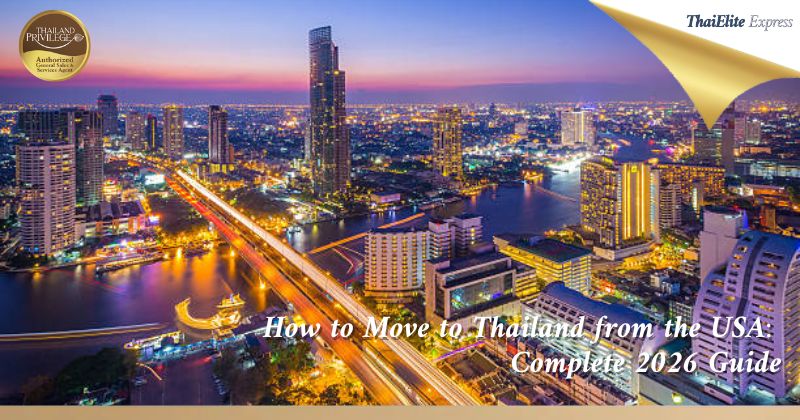
Moving to Thailand from America in 2026 is absolutely doable—but the experience depends on whether you choose the right long-stay visa strategy before you go. This guide explains how to move to Thailand from the USA step-by-step, then compares the most relevant options for US citizens: retirement visas (50+), the Destination Thailand Visa (DTV), business visas, and Thailand Privilege Membership. You’ll also find practical guidance on healthcare, taxes, banking, housing, and cost of living—plus FAQs that address the most common concerns Americans have about living in Thailand long term.
Use this as a “minimum viable” relocation checklist before you book flights:
Thailand offers very different day-to-day realities depending on where you live:
A simple rule: pick the city that matches your daily routine (healthcare access, airports, walkability, noise tolerance), not just your vacation preferences.
Before you move, shortlist two visa routes: your primary plan and your backup.
In 2026, most Americans choosing a Thailand long-term visa pathway fall into one of these groups:
A strong relocation plan includes:
If you’re comparing relocation options beyond Thailand or planning an international move as part of a broader global mobility strategy, it’s worth reviewing country-specific relocation requirements before making a final decision. Check it out at FTB Mobility.
At minimum, arrive with:
If you’re 50+ and considering certain retirement visas, insurance may be part of the visa requirements (details below).
This avoids the common mistake of signing a lease based on photos and ending up far from transit, noisy nightlife, or inconvenient healthcare.
Opening a Thai bank account can depend on your visa type and bank policies. Many Americans live comfortably with:
If you choose Thailand Privilege Membership, the program itself publishes guidance indicating members may be eligible to open accounts with certain banks (more on this below).
If you’ll work online:
Also: visa compliance matters. “Working remotely” can be a gray area depending on your status and activity. When in doubt, get professional advice rather than guessing.
For most Americans, it’s cheaper and easier to buy locally than ship a household—especially for furniture and appliances. Consider shipping only:
In your first 7 days:
The “move” isn’t complete until your stay is stable. Put reminders for:
If you want to retire in Thailand, the most common routes involve Non-Immigrant retirement categories (often referred to as O, O-A, or O-X).
Tradeoff: retirement pathways can be cost-effective, but expect recurring administration (extensions/reporting) and financial maintenance planning.
エリート DTV is designed for longer, more flexible stays—especially for:
Published Ministry of Foreign Affairs materials describe DTV as a multiple-entry visa valid for 5 years, with 180 days per entry. Embassy-issued checklists commonly reference financial proof (often bank statements with a minimum balance) and proof of income/employment or activity.
Tradeoff: requirements can be document-heavy and vary by Thai embassy/consulate.
A business/work pathway is typically used if you will:
Tradeoff: it’s usually paperwork-intensive and often ties into separate work authorization steps. It’s the right route for true local employment—but not the simplest for lifestyle movers.
Thailand Privilege Membership is a paid, long-stay membership program designed for foreigners who want predictable long-term stays and member services.
The official Thailand Privilege site lists membership options from 5 to 20 years with published fees (for example: Bronze 5 years, Gold 5 years, Platinum 10 years, Diamond 15 years, Reserve 20 years by invitation). Importantly for real-life relocation, the program publishes guidance on stay extensions, 90-day reporting support, bank account opening guidance for members—which can reduce the “admin burden” that frustrates many long-stay residents.
Tradeoff: it’s a higher upfront cost than many visa routes, but can be one of the lowest-hassle options for qualified budgets.
| Option | Best for | Stay structure (high level) | Upfront requirements (typical themes) | Ongoing admin | Work allowed? (high level) | Complexity |
| Retirement (O / O-A / O-X) | Americans 50+ who want long stays | Often annual extensions; O-X is longer | Age 50+, financial evidence; O-A includes insurance requirements per consular guidance | Extensions + reporting, plus financial maintenance | Generally が for employment | Medium |
| DTV | Remote workers/freelancers; soft power activities | Multi-year validity; 180-day stays per entry are described in published materials | Proof of funds/income; employment/activity documentation (varies by embassy) | Extensions may be possible; documentation scrutiny | Not a “Thai job” visa; seek advice for remote work compliance | Medium–High |
| Business (Non-Immigrant B) | Thai employment, business operators | Linked to employment/company requirements | Employer/company documents; often work authorization process | Renewals, reporting, work authorization compliance | Designed for legal local work (with proper authorization) | High |
| Thailand Privilege Membership | Long-stay lifestyle movers, frequent travelers, retirees, families who want fewer recurring visa tasks | Membership 5–20 years; program guidance discusses 1-year stay extensions for PE visa holders | Membership fee + background checks; generally fewer financial proof obligations vs retirement/DTV | Program publishes support for reporting/extension steps; still requires compliance | Not designed as a work visa | Low–Medium |
Thailand can be significantly cheaper than many US cities, but your costs depend heavily on location and lifestyle.
Thailand is well known for modern private hospitals in major cities and medical tourism. Many expats use private facilities in Bangkok, Chiang Mai, and Phuket—often with English-speaking staff and international patient services.
Practical tips for Americans:
Taxes are one of the biggest “hidden” relocation issues for Americans.
US citizens typically continue to have US tax filing obligations. The IRS Foreign Earned Income Exclusion (FEIE)explains how eligible Americans living abroad may reduce double taxation. Americans with international assets, cross-border businesses, or multiple tax residences should also consider obtaining professional legal and tax planning advice before relocating.
Thailand’s tax treatment can depend on your tax residency status and how income is sourced and remitted. Recent guidance widely discussed by major tax firms indicates changes affecting foreign-sourced income remitted into Thailand for tax years from 2024 onward.
Important: This is not tax advice. Before relocating, speak to:
Opening a Thai bank account can be easy in some situations and difficult in others. Policies vary by bank, branch, and your immigration status.
Thailand Privilege publishes member guidance indicating eligibility for bank account opening with certain banks (such as Bangkok Bank and Kasikorn Bank), which can be meaningful for people who want local transfers and QR payments.
Even if you think you know where you want to live, do 2–4 weeks in a monthly rental first. Then choose a long-term condo/house after you’ve tested:
You can visit and explore, but relocating without a visa strategy increases the risk of overstays, last-minute exits, or picking a visa that doesn’t match your real lifestyle (remote work, family needs, long-term stay).
No. Thailand Privilege is a membership-based long-stay program, not the same legal status as Thai permanent residency.
If you choose a true long-stay solution (retirement, DTV, business, Privilege), your plan should focus on staying compliant through extensions/reporting, not repeated border runs.
In major cities, private hospitals are modern and widely used by expats. The key is choosing the right facility for your needs and having a coverage plan.
If you’re leaning toward Thailand Privilege Membership as the most convenient long-stay route, ThaiElite Express can help you apply with clarity and fewer surprises.
What ThaiElite Express does:
Visit: https://thaielite-express.com/
The easiest route depends on your profile. For many Americans who want long-term stay with fewer renewals, Thailand Privilege Membership is often the most straightforward. For budget-focused retirees (50+), retirement visa pathways can work well. For remote workers who can document income and funds, the DTV may fit.
Common long-stay options include retirement visas (50+), the DTV, business visas (for Thai employment/business), and Thailand Privilege Membership. The right choice depends on age, work plans, and how much ongoing visa administration you want.
Yes. Buying property is not required to retire in Thailand. Most retirement pathways focus on age and financial evidence, plus insurance requirements for certain categories.
It depends on your visa type and your activities. Remote work is not the same as Thai employment, but compliance can be nuanced. If you plan to work online consistently, choose a visa strategy intentionally (DTV may be relevant) and seek professional advice.
Published Thai government materials describe DTV as a multi-year, multiple-entry visa intended for “workcation” profiles (remote workers/freelancers) and Thai soft power activities, with dependents allowed in certain cases. Requirements and documentation vary by embassy/consulate.
A retirement visa is age-based (50+) and commonly involves ongoing extensions and financial maintenance. Thailand Privilege Membership is a paid membership program designed for long stays, with published guidance on services like reporting support and stay extensions—often reducing ongoing administrative load.
No. Thailand Privilege Membership is a long-stay membership/visa arrangement and does not equal Thai permanent residency or citizenship.
Timelines vary depending on background checks and program processing capacity. Many applicants plan for several weeks rather than days. Avoid booking non-refundable plans around a guaranteed date until you have written approval.
Often yes, but the mechanism depends on the visa route. DTV materials reference spouses and children under 20 in certain cases, and Thailand Privilege has family-related options depending on tier and program rules. Always confirm the current requirements for your exact situation.
US citizens generally still have US tax filing obligations. You may be able to reduce double taxation using tools like FEIE and foreign tax credits, depending on eligibility. Consult a US expat tax professional.
Sometimes, yes—but it depends on your immigration status and the bank’s policy. Thailand Privilege publishes guidance indicating members may be eligible to open accounts with certain banks, while other visa holders may face more variability.
Overstays can lead to fines, complications, and potential bans depending on severity. Treat immigration compliance as non-negotiable: track your permitted stay and extension dates.
Many Americans find Thailand less expensive than major US metro areas, but costs vary by city and lifestyle. Bangkok and beach destinations can be significantly more expensive than inland cities. Rent is usually the biggest swing factor.
Start with a consultation through https://thaielite-express.com/. ThaiElite Express can help you choose the right tier, prepare documents, submit the application, and guide you through the approval and payment process.
The best move you can make before relocating is deciding how you want to live in Thailand—how long you’ll stay, whether you’ll work, and how much ongoing immigration administration you’re willing to manage. Retirement visas, the DTV, and business visas can all be excellent fits for the right person. But if your priority is long-term stay with fewer recurring renewals and more guided support, Thailand Privilege Membership is often one of the most convenient pathways for Americans in 2026.
If you want to confirm whether Thailand Privilege Membership fits your timeline, travel pattern, and long-stay goals, request guidance from ThaiElite Express here:
https://thaielite-express.com/
Discover how Thailand became a G25 economy through manufacturing, tourism, healthcare, digital innovation, and foreign investment—and why more foreigners are...
詳しくはこちらDiscover the best cities to live in Thailand based on lifestyle, cost of living, healthcare, schools, internet, and long-term residency...
詳しくはこちらCompare Thailand vs Dubai across taxes, business, cost of living, weather, healthcare, family life, and residency options before relocating in...
詳しくはこちらThai Elite Express is operated by HLG (Thailand) Co., Ltd., a duly licensed General Sales Agent of the Thai Elite program and Thailand Privilege Card Co., Ltd. since 2013.