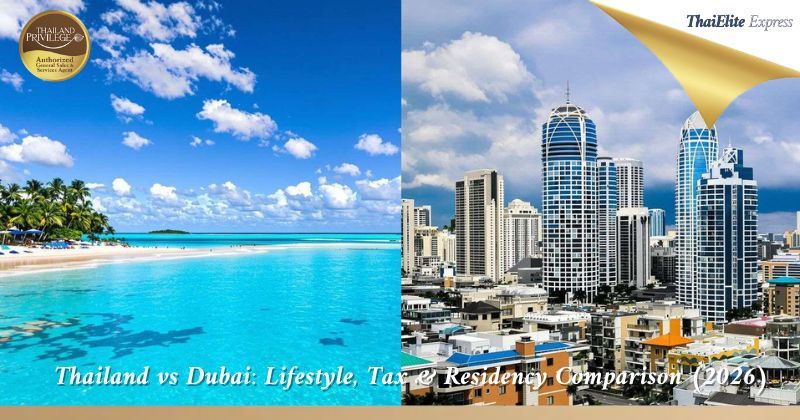
Choosing between Thailand and Dubai (UAE) is rarely about one single factor. It’s about the mix: tax exposure, weather comfort, cost of living, business setup realities, family needs, lifestyle preferences, and how easy it is to stay long term—legally and predictably. When comparing Thailand vs Dubai, it’s important to look beyond taxes and consider lifestyle, residency options, healthcare, business opportunities, and long-term quality of life.
This guide compares Thailand vs Dubai across those categories and ends with a clear “who it suits” summary so you can shortlist based on how you actually live and work.
Quick comparison table: Thailand vs Dubai
| Category |
Thailand |
Dubai (UAE) |
| Tax (high level) |
Progressive personal income tax; tax residency rules matter (commonly 180+ days). Foreign income remittance rules have changed since 2024 (get professional advice). |
No personal income tax on individuals is a common headline; corporate tax exists (0% up to a threshold, then 9%—rules vary by entity/free zone). |
| Weather |
Tropical: hot season + rainy season + cooler season. Humidity is a daily reality in many areas. |
Desert: extremely hot summers; much of life shifts indoors for several months. |
| Cost |
Often lower rent and daily spending; big range by city (Bangkok vs Phuket vs Chiang Mai). |
Generally higher housing, schooling, and lifestyle costs—especially in prime areas. |
| Business vibe |
Strong tourism/service economy + ASEAN proximity; more bureaucracy/navigation needed for some setups. |
Regional hub feel (MENA focus), international workforce, structured business zones and processes. |
| Family |
Many international schools; generally more budget flexibility, but location matters. |
Extensive international school ecosystem; fees can be high, highly organized expat infrastructure. |
| Lifestyle |
Beaches, islands, food culture, wellness, variety of living environments. |
Modern city convenience, events, dining, shopping, global transit hub. |
| Residency |
Multiple routes; Thailand Privilege Card offers 5–20 year membership tiers with a long-stay visa mechanism. |
Residence commonly via employment, company formation, investor/property routes; Golden Visa is a major long-term pathway for eligible categories. |
Tax: personal + business (what changes in real life)
Tax is the most misunderstood part of “Thailand vs Dubai.” The correct answer depends on where you are tax resident, where your income is sourced, and how you’re paid (salary/dividends/capital gains).
Dubai / UAE tax basics (2026)
- The UAE is widely described as having no personal income tax on individuals.
- The UAE introduced corporate tax for many businesses: 0% up to AED 375,000 taxable income and 9% above(with specific rules for free zones and qualifying income).
- The UAE also has VAT at 5%.
Practical implication: Dubai often works well for founders and internationally mobile professionals who want a Middle East hub and a tax structure that can be favorable depending on their home country rules.
- Thailand typically treats you as a tax resident if you are in Thailand for an aggregate of 180 days or more in a tax year.
- Thailand has progressive personal income tax (top rates apply at higher income levels).
- There has been a major shift in how Thailand treats foreign-sourced income remitted into Thailand for Thai tax residents starting from income earned from 1 January 2024 onward. This area is technical and needs professional advice.
- Thailand VAT is commonly 7% (the legal framework and extensions are government-driven).
Practical implication: Thailand can still make sense for many lifestyles and business models, but you should not assume “living in Thailand” is tax-neutral—especially if you become tax resident and remit income.
Ask your tax adviser these questions (use this checklist)
- Where will I be tax resident in 2026?
- Is my income Thailand/UAE-sourced or foreign-sourced?
- Am I paid as salary, dividends, or capital gains?
- Do I manage a company “onshore” (local management) in either jurisdiction?
- Do double tax treaties apply to my case?
- If in Thailand: what counts as remittance and what documentation should I keep?
Important: This article is general information, not tax advice. Tax outcomes can change dramatically based on nationality, residence, and structure.
Weather: comfort, outdoors, and what it means day-to-day
Thailand weather reality
Thailand is tropical. Most of the country follows three broad seasons:
- Hot season: around mid-February to mid-May
- Rainy season: around mid-May to mid-October
- Cooler season: around mid-October to mid-February
Daily-life impact
- You can live outdoors more comfortably in the “cool season,” especially in Bangkok and the north.
- Rainy season affects commute planning, weekend trips, and sometimes air quality or flooding in certain areas.
If you hate humidity: Thailand can feel sticky most of the year in coastal areas and Bangkok.
Dubai weather reality
Dubai’s climate is desert, and summers are commonly described as extremely hot and humid, with average summer highs in the 40°C range.
Daily-life impact
- Many residents shift to indoor routines (malls, gyms, indoor activities) for several months.
- Outdoor social life becomes a “winter season” activity.
If you hate extreme heat: Dubai summers can be a dealbreaker unless you’re comfortable living largely indoors.
Cost: housing, schooling, healthcare, transport
One of the biggest differences in Thailand vs Dubai is the overall cost of living, with Thailand generally offering a more affordable lifestyle for many international residents. Costs swing heavily based on neighborhood and lifestyle, but directionally:
Housing
- Thailand: Rent is often significantly lower than Dubai for comparable space (Bangkok is typically cheaper than central Dubai; Phuket can be pricey in peak areas).
- Dubai: Prime areas and newer buildings can push costs up quickly, and housing is a larger share of most budgets.
Food and groceries
- Thailand: Eating out can be inexpensive, especially local restaurants; imported groceries can raise costs.
- Dubai: Dining out can range widely, but many day-to-day items and restaurants skew higher—particularly licensed venues.
Schooling (international schools)
- Thailand (Bangkok): Many international schools publish fees in the mid-to-high hundreds of thousands THB per year depending on year group and school.
- Dubai: There is a large KHDA-regulated international school market, but top-tier fees can be high—especially for premium curricula and campuses.
Healthcare
- In both places, most expats rely on private healthcare and insurance arrangements.
- The “best” system depends on your expectations (specialist access, language, hospital network, insurance terms).
Transport
- Bangkok: You can combine BTS/MRT + taxis/ride-hailing, though traffic can still dominate.
- Dubai: Many residents are effectively car-dependent, with exceptions in certain central districts and metro-connected corridors.
Business: market access, setup, banking, hiring
Understanding residency pathways is an essential part of any Thailand vs Dubai comparison, especially for individuals planning to relocate for several years.
Dubai: strong for “hub” businesses
Dubai is often chosen for:
- Regional management and sales coverage (MENA time zones)
- International hiring and expat business networks
- Structured business ecosystems (including zones geared to certain industries)
Typical good fit business models
- Regional HQ functions and client services
- Trading/import-export
- Professional services targeting MENA
- Founder-led ventures needing international mobility
Thailand: strong for ASEAN-adjacent operators and lifestyle-based founders
Thailand is often chosen for:
- Operating cost control (compared with many global cities)
- Lifestyle-driven location choice with solid infrastructure
- ASEAN proximity and time-zone advantages for Asia-Pacific
Typical good fit business models
- Consulting, agencies, remote-first teams
- Hospitality and tourism-adjacent businesses (with proper licensing)
- E-commerce and creative industries (structure-dependent)
Common friction points to mention (neutral)
- Banking onboarding can be strict in both places depending on profile.
- In Thailand, some business and employment permissions require more careful compliance planning.
Family: schools, safety feel, community, spouse considerations
Thailand for families
- Wide range of international schools (Bangkok strongest concentration; Phuket and Chiang Mai also popular).
- More flexibility to choose between city living and calmer areas (or beach towns).
- Family budgets can go further—but don’t underestimate schooling and housing in premium zones.
Dubai for families
- Highly structured expat ecosystem, with extensive school choice and organized family activities.
- Strong “convenience infrastructure” (services, delivery, facilities).
- Budget needs can rise quickly with school fees, housing, and lifestyle choices.
Questions to ask before moving with kids
- What’s our school shortlist and application timeline?
- Do we want walkability or are we fine being car-based?
- What’s our healthcare plan (maternity/pediatrics/specialists)?
- Will a spouse need work authorization, and how will residency support that?
Lifestyle: pace, culture, travel, “how it feels”
Thailand lifestyle
- Variety is the big advantage: Bangkok energy, islands and beaches, mountain towns, wellness culture, food scene.
- Easy regional travel across Southeast Asia.
- More options to “downshift” while still having modern conveniences in key areas.
Dubai lifestyle
- Modern city living, global dining, events, and retail.
- Efficient “city convenience” for many daily tasks.
- Very travel-friendly as a base for Europe, Africa, and South Asia.
Practical difference
- Thailand tends to offer more outdoor variety year-round (with rain planning).
- Dubai offers a highly managed city lifestyle but seasonal outdoor limits due to summer heat.
Residency: how foreigners stay long term (Thailand vs Dubai)
This is where many decisions become clear: Do you need a long-stay status not tied to an employer? Do you need to work locally? Do you want a stable base for frequent travel?
Common pathways include:
- Thailand Privilege Card (formerly known as Thailand Elite) – membership-based long-stay access
- Retirement-related visas (requirements apply by age/financial profile)
- Work visas and work permits (tied to employment/company compliance)
- Education routes (context-dependent, not a “forever solution”)
Thailand Privilege Card: where it fits (clear, practical explanation)
Thailand Privilege is a membership program that provides a long-stay visa mechanism and member services. As of 2026, official membership tiers include:
- Bronze: THB 650,000 (5 years)
- Gold: THB 900,000 (5 years)
- Platinum: THB 1,500,000 (10 years)
- Diamond: THB 2,500,000 (15 years)
- Reserve: THB 5,000,000 (20 years, invitation-based)
How the visa works in practice: Thailand Privilege content explains the Privilege Entry Visa (PE) allows 1 year per entry, and members manage their stay permission through the standard immigration process.
What it’s best for
- People who want predictable long-stay access without employer sponsorship
- Frequent travelers who want easier re-entry logistics
- Retirees and families who want a stable base (with the right membership tier)
What it is not
- It is not a work permit. If you need to work in Thailand, you must have the correct legal authorization.
How ThaiElite Express helps (without turning this into a sales page)
ThaiElite Express is:
- An Authorized General Sales & Services Agent (GSSA) for Thailand Privilege
- Able to support applications via an online application portal with complimentary consultation
- Known for an approval-first, pay-after-approval flow (you pay after approval, following official instructions)
If you want to understand which membership tier fits your travel pattern and whether you’re likely to pass screening, a low-friction next step is a complimentary eligibility check and tier comparison.
Dubai / UAE long-term residency pathways (overview)
Dubai residence is typically arranged via:
- Employer-sponsored residence
- Company formation (residence linked to your business setup)
- Investor/property pathways (criteria vary)
- Golden Visa categories for eligible applicants (including real estate investors meeting minimum thresholds)
For example, official UAE sources describe the Golden Visa as a long-term residence visa, and official process pages outline real-estate investor pathways tied to property value thresholds.
Typical process steps (high level)
- Entry permit / application submission
- Medical test and biometrics
- Emirates ID and residence issuance
- Ongoing compliance and renewals depending on visa type
Decision checklist: 10 questions that usually settle the debate
- Where will I be tax resident most years?
- Do I need to work locally, or only live locally?
- Is my income mostly foreign-sourced or locally generated?
- How sensitive am I to humidity (Thailand) vs extreme heat (Dubai)?
- What is my housing standard, and how much space do I want?
- Do I need international schooling, and what’s the budget?
- Do I want a base for Asia travel (Thailand) or Europe/Africa/MENA (Dubai)?
- Can I handle a more car-based lifestyle (Dubai) or prefer mixed transport (Bangkok)?
- Do I want residency that’s not tied to an employer?
- How much bureaucracy am I willing to manage personally vs via professional support?
Common mistakes to avoid
- Assuming residency = tax residency automatically
- Choosing based on “cheap vs expensive” social posts without modeling rent + schooling + healthcare
- Confusing a long-stay permission with work authorization
- Not applying early enough when timelines matter (both countries have process steps that can take time)
FAQ
Thailand-focused
1) What is the Thailand Privilege Card (Thailand Elite)?
A membership program (formerly marketed as Thailand Elite) that provides long-stay access via the Privilege Entry Visa mechanism plus member services.
2) How long can I stay in Thailand with Thailand Privilege?
Membership tiers range from 5 to 20 years depending on tier. The Privilege Entry Visa permission is commonly managed as up to 1 year per entry with proper immigration handling.
3) Can I work in Thailand on a Thailand Privilege membership?
Thailand Privilege membership is not a work permit. If you plan to work, you need the correct work authorization under Thai law.
4) How long does Thailand Privilege approval take?
Timelines vary by applicant and screening. Many people plan for multi-week processing. (If timing is critical, apply early.)
5) What does “pay after approval” mean with ThaiElite Express?
It means you apply first, wait for the decision, then pay the membership fee after approval following the official instructions—rather than sending full membership fees upfront.
6) Why use an authorized GSSA like ThaiElite Express?
To reduce errors in submission, confirm current tier details, and follow a clean, auditable payment path after approval—plus get guidance on next steps for visa handling.
Dubai/UAE-focused
7) What are common ways to get UAE residency?
Employment sponsorship, company formation-linked residence, investor/property routes, and long-term visa categories like the Golden Visa (eligibility depends on the category).
8) Do I need to buy property to live in Dubai long term?
No. Property is one route (including certain Golden Visa paths), but many residents are sponsored by employers or hold residence linked to business setup.
9) Is Dubai a good base if I travel frequently?
Yes, for many people—Dubai is widely used as a hub for regional and long-haul travel, especially toward Europe, Africa, and South Asia.
10) How do schooling and healthcare typically work for expat families in Dubai?
Most expat families use private schools and private healthcare/insurance. Costs vary widely by school tier and neighborhood.
Who each country suits
Thailand suits you if…
- You want a lower-cost base with more space and lower day-to-day spending.
- You value lifestyle variety (city + islands + mountains) over a single-city ecosystem.
- You’re comfortable planning around rainy season and humidity.
- You want a long-stay option like Thailand Privilege that’s not tied to an employer.
- Your work is location-flexible, or you can secure the correct Thai work authorization separately.
- You want easy access to Southeast Asia for travel and business.
Dubai suits you if…
- You prioritize a no personal income tax environment and want to structure business activity within the UAE framework.
- You want a global hub with strong regional positioning across MENA.
- You’re comfortable with a car-based, indoor summer lifestyle due to extreme heat.
- You want clearly defined long-term residence pathways such as the Golden Visa (if eligible).
- Your lifestyle preferences lean toward modern city convenience, events, and a highly organized expat ecosystem.
- You can budget for higher housing and schooling costs in prime areas.
Ultimately, the best choice in the Thailand vs Dubai comparison depends on your personal priorities, financial goals, and preferred lifestyle.