
Powered by HLG (Thailand)

Home - News - High-Net-Worth Individuals Moving to Thailand (2026 Guide)

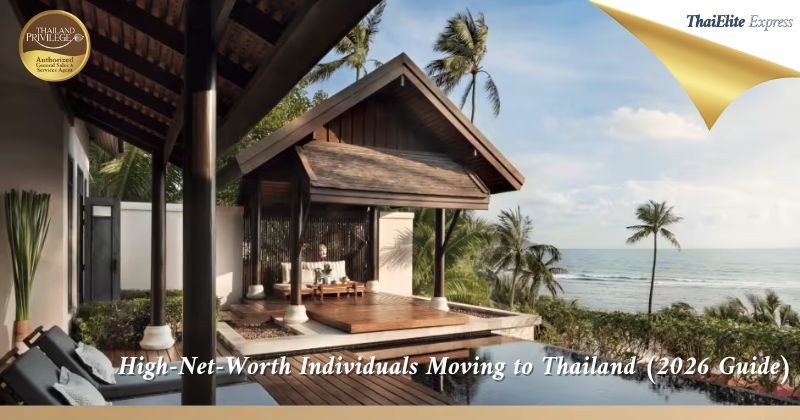
High-Net-Worth Individuals Moving to Thailand (2026 Guide)

High-Net-Worth Individuals Moving to Thailand are choosing the country for luxury living, private healthcare, quality of life, and long-term residency through Thailand Privilege.

High-Net-Worth Individuals Moving to Thailand are increasingly choosing the country for its lifestyle, private healthcare, strategic location, and long-term residency options. In 2026, more high-net-worth individuals (HNWIs) from the US, Canada, the UK, Europe, and Australia are choosing Thailand as a full-time home—or as a “second base.” The reasons go beyond weather and beaches. Thailand offers a rare mix of day-to-day ease, strong private healthcare, luxury living options, and an established service culture. Just as important, long-stay pathways such as the Thailand Privilege Card make it easier for some residents to reduce immigration friction while spending significant time in the country.

For many High-Net-Worth Individuals Moving to Thailand, the combination of quality of life and international connectivity makes the country an attractive long-term base. Below is a practical, non-hype look at what’s driving the move—and what to consider before you relocate.

Why High-Net-Worth Individuals Moving to Thailand Are Increasing in 2026

A major shift for wealthy families in recent years is the move toward multi-jurisdiction living: spending time across two or more countries to diversify lifestyle, risk, and options. In 2026, this “portfolio” approach to residence is widely discussed in the private-wealth world (Henley & Partners describes it as building “sovereign portfolios” of residence rights and long-term access).

Thailand fits this model well because it combines:

  • Regional hub connectivity (Bangkok remains one of Asia’s most connected cities)
  • High-comfort living without constant logistics
  • Mature private healthcare that is accustomed to international patients
  • A service ecosystem designed around convenience (drivers, building staff, concierge support)

On the practical side, air travel capacity is a strong signal of Thailand’s hub role: Airports of Thailand reported Suvarnabhumi Airport (BKK) handled about 62.9 million passengers in 2025, reflecting a return to high-volume global travel patterns.

Quality of Life for High-Net-Worth Individuals Moving to Thailand

For affluent movers, “Thailand quality of life” usually means time saved and friction removed—not “living cheaply.” In many Thai neighborhoods popular with expats, you can structure daily life so that routine tasks take less energy.

Common quality-of-life factors HNW residents cite include:

  • High service density: home maintenance, laundry, deliveries, drivers, and wellness services are easy to arrange
  • Food and social life: Bangkok’s dining scene continues to gain international credibility (including global fine-dining visibility alongside famous local food culture)
  • Choice of lifestyle “modes”:
    • Bangkok for business, hospitals, and international schools
    • Phuket / Koh Samui for resort-style living and villa rentals
    • Chiang Mai for a slower pace and lower-density neighborhoods

What “quality of life” often means for HNW movers

If you’re comparing Thailand to major Western cities, you’ll usually get the most value when your location supports:

  • 20–40 minutes to a top private hospital
  • Fast access to an international airport
  • Building security and professionally managed residences
  • Quiet streets (or a higher floor) plus strong soundproofing
  • A reliable driver/transport plan (more on this under safety)

Private Healthcare for High-Net-Worth Individuals Moving to Thailand

Access to internationally accredited hospitals is one of the biggest advantages for High-Net-Worth Individuals Moving to Thailand. Thailand’s private healthcare system is one of the clearest drivers of relocation—particularly for retirees and families who want speed, specialist access, and predictable service.

A practical example: Bumrungrad International Hospital (Bangkok) reports that it handled over 643,000 international medical episodes in 2024 and notes it was the first hospital in Asia to receive Joint Commission International (JCI) accreditation in 2002. That combination—international patient volume plus globally recognized accreditation—is part of why Thailand is viewed as “ready” for foreign residents who expect a certain standard of care.

What to look for in a private hospital (as a resident, not a tourist)

Instead of relying on marketing claims, evaluate hospitals the way you would anywhere else:

  • Accreditations (JCI is a commonly referenced one for international benchmarking)
  • English communication in nursing, pharmacy, and billing—not only with doctors
  • Specialist depth in the areas you care about (cardiology, orthopedics, oncology, etc.)
  • Insurance compatibility and clear billing workflows
  • Location and traffic reality (a 6 km drive can be slow during peak hours)

Luxury Property for High-Net-Worth Individuals Moving to Thailand

Luxury real estate continues to attract High-Net-Worth Individuals Moving to Thailand who are seeking premium residences in Bangkok, Phuket, and other key destinations. Thailand’s luxury property market gives HNW residents choices across:

  • High-rise CBD condos with strong security and facilities
  • Serviced residences for lower-maintenance living
  • Resort-style villas in island markets (often rented long-term; ownership structures vary)

The reality for foreign ownership (high-level)

Foreigners often focus on condominiums, because this is the cleanest ownership category under Thai rules. Thai government guidance commonly cites the 49% foreign ownership cap within any condo building/project (the foreign quota). Landed property is more complex and should be approached with qualified, Thailand-licensed advice.

What luxury pricing looks like in Bangkok (2026 snapshots)

Bangkok prices vary sharply by neighborhood and building quality. A useful reference point is Cushman & Wakefield’s Bangkok condominium research for Q1 2026. It showed prime central submarkets with average launched prices (indicative, not universal) such as:

  • Central Lumpini: ~THB 305,000/sqm
  • Sathorn–Silom: ~THB 266,333/sqm
  • Sukhumvit: ~THB 242,130/sqm
  • Pathumwan–Phayathai: ~THB 373,486/sqm

These figures help explain why many wealthy newcomers rent first: it’s a fast way to test commute times, building management, noise, and neighborhood fit before making long-term commitments.

Due diligence checklist (renting or buying)

  • Confirm building juristic office quality and maintenance standards
  • Review house rules (pets, renovation permissions, short-term guests)
  • Verify parking reality if you plan to own a car
  • For purchases: confirm the unit’s eligibility under the condo’s foreign quota
  • Use independent legal review for contracts and title/transfer documents

International banking and financial practicality: what’s smooth, what’s not

Efficient financial services are another reason High-Net-Worth Individuals Moving to Thailand choose the country as a regional base. “International banking in Thailand” can mean two different things:

  1. Day-to-day banking inside Thailand (local transfers, bill pay, mobile banking, debit cards)
  2. Cross-border wealth management (custody, multi-currency strategy, investment platforms)

For many HNW residents, the most practical setup is:

  • Keep primary assets with established institutions in major financial centers
  • Maintain a Thai account for local spending, rent, school fees, and utilities

The key point: account opening can be compliance-heavy

In 2026, foreign account opening is often shaped by bank compliance requirements and branch policy. Thai government guidance notes that many banks may request documents such as a work permit (or other supporting documentation) to open accounts for foreigners, and requirements can vary.

This is also where structured long-stay status can matter: some long-stay residents use service channels associated with their residency pathway to make the process more predictable—while still understanding that bank approval is never guaranteed.

What HNW residents typically do to reduce friction

  • Prepare documentation early (proof of address, residency-related documents, source-of-funds explanations where needed)
  • Use reputable, transparent transfer methods and keep records
  • Work with qualified tax and legal professionals for cross-border structuring (especially if you split time across countries)

Safety and stability: what affluent families and retirees evaluate

A fair way to assess “is Thailand safe for expats” is to separate daily-life safety from systemic risks.

Daily-life safety

Safety, convenience, and premium amenities contribute to the growing number of High-Net-Worth Individuals Moving to Thailand each year. In Bangkok and major expat areas, many affluent residents prioritize:

  • Buildings with 24/7 security and controlled access
  • Well-lit neighborhoods with strong foot traffic
  • Conservative personal security habits (as in any large city)

Thailand’s country-level safety picture is mixed depending on the metric. For instance, the Global Peace Index 2025 ranked Thailand 86th, which is neither “unsafe” nor “top-tier safest”—it signals a mid-range profile at a national level.

The risk that deserves more attention: road safety

For new arrivals, the most practical safety issue is often transportation. The World Health Organization highlighted Thailand’s road traffic death rate of 25.4 per 100,000 population (2021), describing it as among the highest in Asia.

Many HNW residents mitigate this by:

  • Using professional drivers more often than self-driving
  • Choosing housing that reduces cross-city commuting
  • Avoiding motorbike travel unless experienced and properly insured

Safety checklist for newcomers

  • Choose housing with strong security and emergency procedures
  • Arrange medical insurance appropriate for private hospitals
  • Use professional drivers for late-night or long-distance travel
  • Save local emergency numbers and your hospital’s emergency contact
  • Review liability and property coverage (especially if you own vehicles)

The concierge lifestyle: why Thailand can feel unusually “easy”

Thailand’s concierge lifestyle is less about luxury branding and more about coordination. In practical terms, “easy” living often comes from:

  • Airport assistance and smoother arrivals/departures
  • Staffed buildings that handle parcels, maintenance access, and vendor scheduling
  • On-demand wellness: physiotherapy, health checks, spa services, trainers
  • High-quality hospitality and property management standards in many prime buildings

This is also where Thailand Privilege fits naturally for some residents: the program is structured around long-stay residence plus service features that reduce routine admin.

Residency Options for High-Net-Worth Individuals Moving to Thailand

Thailand has multiple long-stay options depending on your profile (retirement, work arrangements, investment, family situation). One of the most widely used by affluent long-term residents is the Thailand Privilege Card (formerly Thailand Elite). Many High-Net-Worth Individuals Moving to Thailand choose Thailand Privilege Membership because it offers a straightforward long-term residency option. 

What the Thailand Privilege Card is

Thailand Privilege is a long-stay membership program with packages from 5 to 20 years. The official program lists tiers including:

  • Bronze: THB 650,000 (5 years)
  • Gold: THB 900,000 (5 years)
  • Platinum: THB 1,500,000 (10 years)
  • Diamond: THB 2,500,000 (15 years)
  • Reserve (invitation-only): THB 5,000,000 (20 years)

Beyond the long-stay component, program materials and updates describe service features such as airport support/fast track, member contact services, and administrative assistance categories (for example, liaison support that can include bank-account-opening appointments in certain cases).

Who it tends to suit

  • Frequent travelers who want predictable long stays without repeated visa runs
  • Retirees who want convenience and reduced paperwork
  • Families and “semi-residents” splitting time between Thailand and the West

Applying with ThaiElite Express (where we fit)

ThaiElite Express is an authorized General Sales & Services Agent (GSSA) for the Thailand Privilege program and a subsidiary of Harvey Law Group Thailand. We provide:

  • A streamlined online inquiry process
  • Complimentary consultation
  • Application guidance and document checks
  • A pay-after-approval policy (you don’t pay the membership fee before approval)

Processing times can vary depending on background checks and program workload, so it’s best to plan with a reasonable timeline buffer rather than expecting a fixed number of weeks.

Practical checklist before relocating to Thailand (2026)

Use this as a pre-move framework:

  • Define your stay pattern: full-time, seasonal, or “3–6 months per year”
  • Pick location based on your priorities:
    • nearest preferred private hospital
    • international airport access
    • schools (if applicable)
    • noise/traffic tolerance
  • Banking plan:
    • local account for daily life
    • international accounts for custody and multi-currency needs
  • Housing plan:
    • rent first in your target neighborhood
    • assess building management quality
  • Immigration plan:
    • select a legal pathway that matches how often you’ll enter/exit
  • Insurance:
    • health + liability + property as needed
  • Transport plan:
    • driver options, car purchase, safe routes
  • Tax and compliance:
    • get qualified cross-border advice early if you have complex income sources

High-Net-Worth Individuals Moving to Thailand continue to benefit from Thailand’s world-class healthcare, infrastructure, and international lifestyle.

If you’re one of the High-Net-Worth Individuals Moving to Thailand, ThaiElite Express can help you explore the most suitable Thailand Privilege Membership for your long-term plans.

FAQs

1) Is Thailand a good place to live for wealthy expats in 2026?

For many, yes—especially if you value service convenience, private healthcare access, and a high-comfort lifestyle. The best outcomes usually come from choosing the right neighborhood, building, and long-stay structure for your travel pattern.

2) How good are private hospitals in Thailand compared with Western countries?

Top private hospitals in Thailand are accustomed to international patients and often highlight international accreditation. For example, Bumrungrad reports large international patient volumes and states it was JCI-accredited in 2002. Your experience will still vary by hospital, department, and how you manage follow-up care.

3) Can foreigners buy luxury property in Thailand?

Foreigners commonly purchase condominiums, subject to the project’s foreign quota (often referenced as a 49% cap). Landed property ownership is more complex and should be approached with proper, Thailand-licensed legal advice.

4) Is Thailand safe for families and retirees?

Many families and retirees live comfortably in Thailand, particularly in well-managed buildings and established neighborhoods. However, road safety is a key risk area, and many residents adjust by using drivers and planning transport carefully (WHO road safety guidance is a useful reference point).

5) How does international banking work when living in Thailand?

Most HNW residents use a two-layer approach: keep primary wealth and investments with international institutions, while maintaining a Thai account for local expenses. Account opening can be documentation-heavy, and bank requirements vary.

6) What is the Thailand Privilege Card (formerly Thailand Elite)?

It’s a long-stay membership program offering residence options from 5 to 20 years depending on the tier, alongside service features (airport support and administrative assistance described in program materials).

7) How long does Thailand Privilege approval take?

Timelines vary due to background checks and operational volume. Plan for a flexible processing window rather than a guaranteed timeframe.

8) Do I have to pay before approval when applying through ThaiElite Express?

No. ThaiElite Express uses a pay-after-approval approach: you proceed with payment after your application is approved.

9) Can my spouse and children be included?

Some Thailand Privilege tiers allow family add-ons or related memberships, depending on the package rules at the time of application. The practical step is to confirm eligibility and costs during a consultation.

10) Do I need a lawyer to apply for Thailand Privilege?

Not always. Many applicants use an authorized agent for guidance and document handling. Legal advice can be helpful if your situation is complex (prior immigration issues, name changes, sensitive documentation, or broader cross-border planning).

Next steps (keep it simple and practical)

If Thailand is on your 2026 shortlist, start with a plan—not a property viewing:

  1. Shortlist two locations (e.g., Bangkok + one resort area)
  2. Identify your preferred hospital and living radius
  3. Decide whether you need true long-stay predictability (and which pathway fits)
  4. Build a banking and documentation checklist before you arrive
  5. If Thailand Privilege is relevant, request a complimentary consultation with ThaiElite Express to compare tiers and map a realistic timeline.


Stay in Thailand long-term.
With a Privilege Entry Visa
that is valid from
5 years up to 20 years.

Contact us directly via WhatsApp

Share this article

Become an
Elite Member

NOW

Frequently asked questions

Who is eligible for Thai elite visa?
The applicant/the Member must have and maintain to have the following qualifications: Being allowed to stay in Thailand in accordance with the immigration laws or any related law of Thailand.(no overstay record) Holding foreign passport. Not having been sentenced by a judgment to imprisonment in any countries except for an offense committed through negligence. Not having been adjudicated bankrupt. Not having been declared as a person of unsound mind incompetence, or quasi incompetent.
How long can I stay in Thailand with Elite Visa?
Thailand Elite offer a 5,10 or 20 years membership and ensure the renewal of your visa during the validity of the membership. Each time a member goes through the Thai immigration, he/she will automatically get a one-year visa stamp in his/her passport until expiration of the membership. If the member happens to stay for more than 1-year consecutively in Thailand, then a simple renewal at the immigration office will grant another 1-year visa stamp.
Is Thailand Elite a scam?
The Thailand Elite Visa is a program initiated and approved by the Royal Thai government in 2003. The Thailand Privilege Card Co., Ltd, which runs the Elite Visa program is a fully owned subsidiary of the Tourism Authority of Thailand, under the Ministry of Tourism and Sport. ThaiElite-Express empowered by HLG Law Firm is an authorized sale agent.
Can I work with Thailand Elite?
After becoming an Elite member and obtaining your Thailand Elite Visa, you can apply anytime to a non-immigrant business visa and a work permit allowing you to work in Thailand. You also have the option of applying to the Elite Flexible Plus, invest at least 1 million USD in Thailand either in real estate, a limited or public company, or in stock exchange, and be granted a work permit.
How do I pay for Thailand Elite?
The payment is required only after submission of your application, the immigration background check by the Thai immigration, and receipt of the Approval Letter by email. Applicants could then choose to proceed to their membership fee by local or overseas bank transfer, credit card or depositing money to Thailand Elite bank account directly.
Is the Thailand Elite visa for Digital Nomads?
The Thailand Elite Visa is perfectly suitable for Digital Nomads. As business or retirement visas are not necessary a good match for digital nomads, the Elite Visa answers to all nomads with numerous privileges to cater members’ needs. With very little documentation needed, as well as the flexibility of applying from anywhere, regardless abroad, on arrival, or within Thailand. The process is seamless and fast. Moreover, from a study by The Instant Group, Bangkok has recently been voted as the world’s second-best city to work in as a digital nomad (best city in Asia). This is down to the innumerable benefits in which Bangkok brings, which are but not limited to; Internet broadband speed, culture, scenery, transportation, weather, affordability, cuisine, and more. Having already welcomed 35 million digital nomads from all over the world, in 2021, it’s forecasted that there would be more arrivals to the Land of Smiles with constant technological and infrastructure improvements.
What is the long term visa available in Thailand?
Applying to a Thailand Elite program is a viable and easy solution to stay and live for a long period of time in Thailand. Only Thailand Elite can offer a 5,10 or 20 years membership and ensure the renewal of the visa during the validity of the applicant membership. As of today, all other non-immigrant visa options are limited to a validity period of 1 or 2 years.
Thailand elite vs Retirement Visa
To retire in Thailand, the Elite Visa is a worry-free option compared to the Retirement Visa from the application, during holding period to the renewable. At the application time, for an Elite, the documentation is minimal, and no medical insurance nor proof of funds is required for instance. During the holding period, Elite members enjoy numerous privileges such as an assistance for their 90 days report, a fast track at the airport immigration, the lounge access and airport limousine, assistance in opening a bank account in local or foreign currency, a 24/7 call center and much more. The Elite Visa offers you an easy renewable of the Privilege Entry Visa for the duration of your membership.
What is the long term visa available in Thailand?
Applying to a Thailand Elite program is a viable and easy solution to stay and live for a long period of time in Thailand. Only Thailand Elite can offer a 5,10 or 20 years membership and ensure the renewal of the visa during the validity of the applicant membership. As of today, all other non-immigrant visa options are limited to a validity period of 1 or 2 years.
Is the Thailand Elite Visa legit?
The Thailand Elite Visa is a legal and legit program under Thai law to stay long-term in Thailand. The “Thailand Elite” is operated by Thailand Privilege Card Co., Ltd. It has been initiated in 2003 by the Royal Thai Government itself. The company is fully owned subsidiary of the Tourism Authority of Thailand, under the Ministry of Tourism and Sport.

Related Articles

High-Net-Worth Individuals Moving to Thailand (2026 Guide)

August 16, 2026

Discover why high-net-worth individuals are moving to Thailand in 2026 for world-class healthcare, luxury property, lifestyle, and long-term residency options.

Read More

Thailand Strategic Location: Asia’s Business Hub (2026)

August 14, 2026

Thailand's strategic location gives entrepreneurs access to ASEAN, China, India, and the Middle East through world-class airports, logistics infrastructure, and...

Read More

Living in Thailand Long Term: Complete 2026 Guide

August 12, 2026

Everything you need to know about living in Thailand long term, including healthcare, cost of living, schools, infrastructure, safety, and...

Read More

Our qualified team will contact you within today.

Thailand Privilege Card representative will contact you shortly with more information.

Our qualified team will contact you within today.

Thailand Privilege Card representative will contact you shortly with more information.