
Thailand Privilege (formerly Thailand Elite) is one of the simplest ways to secure long-stay permission in Thailand,especially if you value predictability and concierge-style support. But it’s not automatically the best fit for every long-stay plan.
This guide walks through the most common situations where you should pause before applying, what to consider instead, and how to compare options based on purpose, cost structure, and work rights. (Immigration rules change and individual circumstances matter,treat this as general information, not legal advice.)
Thailand Privilege is a membership program that provides eligible foreign nationals with a long-stay visa arrangement and member services.
What it is in practical terms:
What it isn’t:
Also important: 90-day reporting still exists for foreigners staying long-term in Thailand, and Thailand Privilege publicly explains the process and penalties for late reporting.
Thailand Privilege may be the wrong tool if any of these are true:
If you’re unsure, ThaiElite Express can help you confirm whether Thailand Privilege is a fit before you invest time in a full application.
Why it may not fit
If you meet retirement eligibility (commonly age 50+ plus financial evidence) and intend to live in Thailand year-round, retirement-based options can be more cost-efficient over time. The trade-off is paperwork: annual extensions, financial evidence updates, and ongoing compliance.
Thailand Privilege is often chosen to reduce friction,but it’s an upfront membership cost that may not be necessary if you’re comfortable with the retirement process.
What to consider instead
A retirement pathway (often Non-Immigrant “O” retirement or related extensions) is commonly documented with financial evidence such as a bank deposit or monthly income threshold, depending on the route and where you apply. Requirements and supporting documents can vary by embassy/consulate and immigration office.
Example scenario
You’re 62, you want to settle in Chiang Mai full-time, and you don’t travel frequently. If you’re fine renewing yearly and maintaining the required financial evidence, a retirement route may deliver the stay permission you need without paying for a membership program.
Why it may not fit
If your long-stay basis is genuinely your Thai spouse, Thailand Privilege may be a cost mismatch. Marriage-based extensions can be significantly less expensive than a multi-year membership, especially if you’re staying long-term.
What to consider instead
Thai Immigration Bureau documentation for extension of stay based on living with a Thai spouse includes financial qualification options such as monthly income or a Thai bank deposit, and lists supporting documentation requirements.
Example scenario
You’re 38, married to a Thai citizen, and you plan to live in Thailand indefinitely. If you can meet the marriage-extension requirements and are comfortable with the annual process, the marriage route may be the more rational baseline,while Thailand Privilege becomes a convenience upgrade rather than a necessity.
Why it may not fit
Thailand Privilege is about permission to stay, not permission to work. Thailand Privilege materials clearly state the Privilege Entry Visa does not automatically grant a work permit and does not permit work or study under that visa category without proper authorization.
If your plan involves any of the following, you should be careful:
What to consider instead
A common pathway for employment is Non-Immigrant “B”, which is used for business/employment purposes and pairs with the work permit process through the relevant Thai authorities. Thai MFA guidance outlines Non-B usage and typical stay periods at entry.
Example scenario
You’re relocating to Bangkok to join a Thai company as a senior executive. Thailand Privilege may still be useful for convenience in some cases, but it will not replace the Non-B + work permit strategy your employer needs to put in place.
Why it may not fit
Thailand Privilege is not PR. If your primary objective is long-term settlement status, you should plan around the eligibility logic used for PR/citizenship,not around a membership visa alone.
That doesn’t mean Thailand Privilege is “bad”; it means the program’s purpose is long-stay convenience, not a guaranteed settlement ladder.
What to consider instead
If PR/citizenship is the goal, you’ll typically want a long-range plan aligned with legally recognized bases such as employment, family, and long-term compliance records,often requiring careful sequencing and documentation. This is where tailored legal advice matters.
Example scenario
You want to make Thailand your permanent home and eventually pursue PR. If your timeline is 5–10+ years and your strategy depends on work history or Thai family ties, you may need a visa structure that supports that plan more directly.
Why it may not fit
If you’re only coming to Thailand for seasonal visits, a few extended trips, or exploratory stays, the membership cost may be unnecessary,especially if you qualify for visa exemption or a short-term visa that already covers your travel pattern.
Thailand expanded visa exemption for many nationalities to allow up to 60 days per entry (policy updates are subject to change and depend on nationality).
What to consider instead
Example scenario
You spend 2–3 months per year in Phuket and the rest in Europe. If you’re not dealing with frequent renewals or complicated re-entries, Thailand Privilege may be more than you need.
Why it may not fit
If you genuinely plan to study, Thailand Privilege isn’t designed for that purpose. Thailand Privilege content for digital nomads notes that study is not permitted under the Privilege Entry Visa category.
What to consider instead
An Education (ED) pathway is typically the aligned route when your real purpose is study, with a structure based on institutional documentation and ongoing compliance. Thailand government guidance explains that Non-Immigrant ED entries are often granted initially and extended based on approvals and the institution’s status, and long-stay foreigners still need to comply with reporting requirements.
Example scenario
You want to spend a year studying Thai language in Bangkok. If the school is reputable and your intent is study, ED may match your purpose better than paying for a membership you chose only to “stay longer.”
Why it may not fit
Thailand Privilege is simplest when the buyer values time, predictability, and service more than minimizing cost. If your priority is the lowest possible spend, a membership fee may not align with your preferences,especially if you qualify for an annual extension route.
For context, Thailand Privilege’s published membership fees range from THB 650,000 (5 years) に長期滞在 THB 5,000,000 (20 years, invitation-based Reserve tier), depending on the package.
What to consider instead
A budget-focused strategy usually means choosing a visa category that fits your real basis (retirement, spouse, employment, education, or a government program like DTV for eligible remote workers), and accepting the paperwork cadence.
Example scenario
You’re financially comfortable but prefer not to pay upfront for a bundle of services you won’t use. If you can handle annual renewals and documentation, an alternative route may fit your mindset better.
Instead of asking “Which visa is best?”, ask which visa matches your purpose with the least friction.
Use these comparison points:
ThaiElite Express supports clients who want clarity before committing to a membership,and a smoother process if they proceed.
What we do (factually):
If you’re not a fit for Thailand Privilege, a responsible consultation should tell you that clearly,because the “best” option is the one that matches your purpose, budget, and compliance comfort.
Thailand Privilege materials state the Privilege Entry Visa does not automatically grant a work permit, and working under this visa category is not permitted without proper authorization. If you need to work in Thailand, you’ll need a work-capable pathway (such as Non-Immigrant B + work permit, or another qualifying program).
It depends on what you value. Retirement routes can be cost-efficient but involve ongoing administration. Thailand Privilege can be worth it if you prefer an upfront cost in exchange for convenience and reduced renewal friction.
Thailand Privilege is not PR and does not equal citizenship. If PR/citizenship is your primary goal, you should plan around the specific legal requirements for those statuses rather than assuming a membership visa is a direct pathway.
If your stays are short and infrequent, Thailand Privilege may be unnecessary. Depending on nationality, visa exemption may cover many short visits (policy varies by country and can change).
Thailand Privilege has structures for family-related memberships and dependents in certain cases, but the rules depend on the membership tier and current program conditions. A fit check should review your family composition and the most cost-effective structure.
Timelines vary by applicant and background checks. Many applications are processed in weeks, but no agent should promise a fixed approval time. Plan conservatively if you have a hard deadline.
A proper process should clarify what fees are paid at which stage. With ThaiElite Express’s pay-after-approval approach for membership fees, clients typically do not pay the full membership fee upfront before approval,helping reduce financial risk if the application does not proceed.
Thailand Privilege is the current branding of the program formerly known as Thailand Elite. Many people still use “Thailand Elite visa” informally, but the program is now marketed as Thailand Privilege.
The most common reasons are: they qualify for a cheaper route (retirement/marriage), they need a work permit, they only visit short-term, or they want a PR-oriented strategy rather than a convenience membership.
Start with purpose (retire, work, family, study, remote work, travel frequency), then confirm whether you need work authorization and how much administration you’re willing to handle. A consultation can validate fit and reduce expensive mistakes
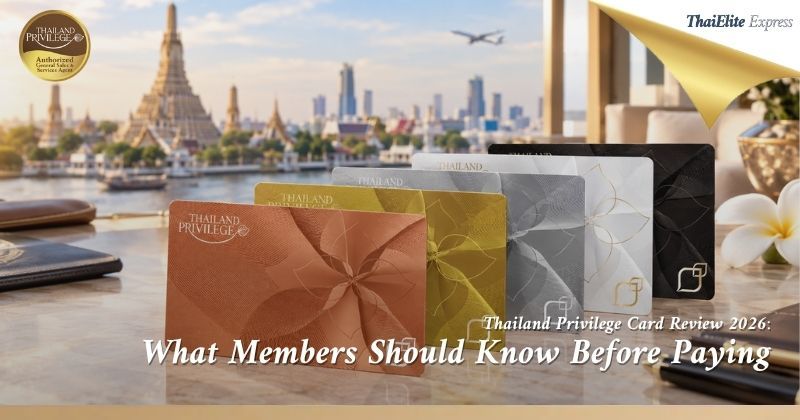
Thailand Privilege Card review 2026 covering costs, key benefits, limitations, membership value, who it suits, and what to consider before...
詳しくはこちらAmericans can apply for the Thailand Privilege Card (formerly Thailand Elite), and many US citizens use it as a straightforward...
詳しくはこちらThailand Privilege Card (formerly Thailand Elite) is a long-stay membership program that combines visa-related convenience with airport services and a...
詳しくはこちらThai Elite Express is operated by HLG (Thailand) Co., Ltd., a duly licensed General Sales Agent of the Thai Elite program and Thailand Privilege Card Co., Ltd. since 2013.