
Powered by HLG (Thailand)

Home - News - Moving to Thailand Long Term: Work, Family, Visas & Life (2026)

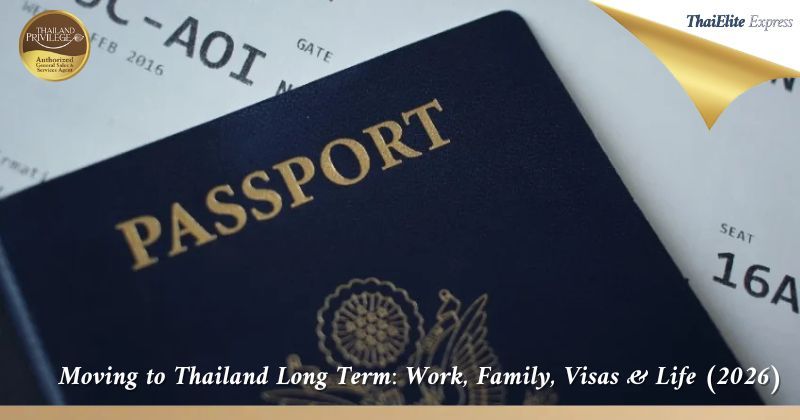
Moving to Thailand Long Term: Work, Family, Visas & Life (2026)

Moving to Thailand Long Term? Learn about remote work, schools, healthcare, business opportunities, taxes, and long-term residency options including Thailand Privilege.

Moving to Thailand is often described like a before-and-after photo: the “trip” version—beaches, night markets, and hotel breakfasts—versus the “life” version—school runs, client calls, doctor appointments, and immigration deadlines. This article walks through that transition in a realistic timeline, covering remote work, raising children, healthcare, community, business opportunities, and long-term residency pathways such as the Thailand Privilege Card (formerly called the Thailand Elite visa).

The moment Thailand stops being a trip

In the beginning, relocation rarely looks like relocation. It looks like an extended stay: a one-month apartment, a plan to “see how it feels,” a promise to keep options open.

In our composite story, it starts with two suitcases and a short lease.

Alex and Maya arrive in Bangkok thinking they’ll stay “a season.” Alex works remotely for overseas clients; Maya is exploring whether Thailand can be a long-term base for their family. They love the convenience and energy of the city—but the shift from vacation to real life happens fast.

It’s usually triggered by one of these moments:

  • You realize you can’t keep hopping between neighborhoods without losing time and money.
  • Your workday starts colliding with time zones and unpredictable routines.
  • You begin comparing school calendars instead of island itineraries.
  • You get sick once—and suddenly you care less about views and more about which hospital to visit.
  • You check your passport stamps and understand the difference between a pleasant stay and a sustainable plan.

Questions most people ask in month one

  • Where should we live if we want a routine, not a nightlife schedule?
  • Can I reliably work from my apartment—every day, not just when the Wi‑Fi is “good”?
  • What will we do for schooling if we stay through the next academic year?
  • Which hospital do expats actually use, and how does insurance work?
  • What is our long-stay strategy—especially if we don’t want constant renewals?

Working remotely from Thailand (what changes and what doesn’t)

Thailand is well set up for modern work—but the practical details matter. Remote work success here is less about finding “a nice café” and more about building a repeatable system: connectivity, workspace, time zone management, and compliance planning.

Internet, workspaces, and daily rhythm

If your work depends on video calls, cloud files, and fast uploads, Thailand’s infrastructure is often more than sufficient in major cities and established expat areas. For example, Ookla’s Speedtest Global Index (May 2026) reported Thailand median fixed broadband speeds in the hundreds of Mbps range, with relatively low latency.

The relocation lesson: don’t judge your work setup from a hotel.

A long-stay routine typically evolves into one of three patterns:

  • Home-first setup: A condo with a real desk, a monitor, and a backup mobile hotspot.
  • Coworking-based workweek: A membership for focus and meetings, plus home for deep work.
  • Hybrid “third place” rhythm: Coworking for calls; quieter cafés for solo tasks; home for admin.

Small decisions compound:

  • Is your bedroom also your office?
  • Do you need soundproofing for calls?
  • Can you handle a power or internet outage without losing a client meeting?

Time zones and client expectations

Remote work becomes easier when you stop pretending you live “on your home schedule.”

  • US clients: Your best working block may be late afternoon through evening.
  • Europe clients: Your day may start early.
  • Global teams: You’ll likely need a dedicated “meeting window” and protect everything else.

Many long-term expats design their week around two non-negotiables:

  1. A consistent sleep schedule (Thailand will tempt you to drift).
  2. A calendar discipline that doesn’t rely on last-minute flexibility.

Compliance basics to think about (without getting lost in legal theory)

Remote work raises questions that travel doesn’t: what visa you’re on, whether you’ll be in Thailand long enough to become tax-resident, and how you’ll structure your life without constant disruption.

Thailand has introduced options that reflect how people live now—for example, the Destination Thailand Visa (DTV) is officially framed for “workcation” profiles such as digital nomads and remote workers (Thai e‑Visa / Thai government communications). For people who qualify, there is also the Long-Term Resident (LTR) visa, which is designed for specific categories like “Work-from-Thailand Professionals” and certain retirees and high-potential individuals.

Separately, if you plan to be in Thailand much of the year, it’s wise to understand tax residency at a high level and get professional advice early. Thailand’s Revenue Department has published guidance (Section 41 framing) on how foreign-sourced income may be treated if you are in Thailand for 180 days or more in a tax year and remit income into Thailand (Revenue Department guidance effective from 2024 onward). This is not something to “figure out later” once you’ve already settled.

Remote work checklist (first 30 days)

  • Set up two internet options (fixed broadband + mobile hotspot).
  • Choose a workspace plan: home desk, coworking, or a hybrid.
  • Define a weekly “meeting window” that matches your clients’ time zones.
  • Keep a digital folder of: passport biodata page, visa pages, entry stamps, lease, and insurance.
  • Decide your stay strategy early (short-term extensions vs a long-term pathway) so immigration admin doesn’t run your calendar.
  • Speak with a qualified tax advisor if you expect to spend most of the year in Thailand.

Raising children in Thailand

Thailand can work extremely well for family life—but it rewards planning. Families who thrive here usually do two things early: they choose schooling options before they choose a long lease, and they design a routine that doesn’t depend on constant “holiday mode.”

School options families typically compare

Most relocating families compare three broad paths:

  1. International schools (varied curricula, often English-led)
  2. Bilingual or English programs (often more budget-flexible, varies widely by school)
  3. Alternative setups (homeschooling/online schooling, tutoring support, mixed models)

The key is to treat schooling as a system, not a label. “International” can mean different things in admissions standards, curriculum, language support, and parent community.

A practical note: international school fees can be significant and vary by year level. Many schools publish fee schedules (for example, Bangkok Prep publishes fees for Academic Year 2025–2026), and broad relocation guides often cite annual ranges from a few hundred thousand baht up to over one million baht depending on school and grade.

Daily family life: what actually changes

After the first few weeks, the day-to-day realities become clearer:

  • Commute is lifestyle. In Bangkok, a short distance can become a long trip at the wrong time.
  • Extracurriculars anchor community. Sports clubs, music lessons, and weekend activities become your social map.
  • Parent networks become logistics networks. Shared advice on pediatricians, tutors, and neighborhoods is often more valuable than any online guide.

Questions to ask schools before you sign

  • What does the admissions timeline look like, and what documents do you need?
  • How does the school support children new to English (or new to the curriculum)?
  • What’s the realistic door-to-door commute in peak traffic?
  • What does the school bus route look like, and how reliable is it?
  • What additional costs sit outside tuition (capital levies, activities, uniforms, exams)?
  • How does the school integrate new families into the community?

Healthcare in Thailand (how expats typically navigate it)

One of the fastest ways Thailand becomes “home” is when you stop treating healthcare as a travel concern and start treating it as part of your routine.

Thailand has a large healthcare system, with public coverage for Thai citizens through the Universal Coverage Scheme framework (NHSO), while many foreign residents and expat families typically rely on private hospitals and clinics, especially for predictable scheduling and international patient services.

Private vs public care (high-level differences)

In broad terms:

  • Public hospitals can be highly capable, but queues, language support, and process navigation can be more complex for newcomers.
  • Private hospitals often offer shorter wait times and more streamlined patient experience, especially in major cities and medical hubs.

For quality signals, some hospital networks in Thailand have facilities accredited by international bodies such as JCI(Joint Commission International), which can be a meaningful reference point when you’re new to the country.

Insurance planning: what to clarify early

Insurance is where many new arrivals underestimate complexity. Before you assume you’re “covered,” clarify:

  • Inpatient vs outpatient coverage (and how deductibles apply)
  • Chronic condition coverage and exclusions
  • Maternity coverage and waiting periods (if relevant)
  • How claims are handled (direct billing vs reimbursement)
  • Coverage when you travel outside Thailand

Continuity of care (the long-stay advantage)

Long-term residents get benefits that tourists don’t:

  • You can establish a primary doctor, not just “the nearest clinic.”
  • You can keep medical records in one place.
  • You can plan elective care and preventative screening rather than reacting to emergencies.

Bring these documents when you move

  • Digital copies of prescriptions and a brief medical summary
  • Vaccination records for children
  • Insurance policy documents and emergency contact numbers
  • A list of allergies and chronic conditions (simple, written, accessible)
  • If relevant: recent test results, imaging reports, and specialist letters

Finding community (and why it affects whether you stay)

Thailand can be socially easy—until it’s not.

In the early weeks, you meet people constantly. But long-term life requires something different: repetition, reliability, and relationships that exist outside the “newcomer bubble.”

Thailand has an established international population (UN estimates put international migrants in Thailand at over three million), which means you’re not trying to build community from scratch. But you still have to choose how you’ll belong.

The most common “staying vs leaving” factor isn’t cost or weather—it’s whether people feel connected.

Three ways newcomers build community faster

  1. Join something that meets weekly (sports, fitness classes, language schools, volunteering).
  2. Anchor in a neighborhood rather than moving every month—community forms through proximity.
  3. Build a “two-layer network”: expat friends for practical onboarding, and Thai connections for deeper understanding and long-term ease.

A small cultural note that matters: Thailand is generally a relationship-forward society. Politeness, patience, and calm communication go further than “being right.”

Business opportunities and ways people earn in Thailand

People move to Thailand for lifestyle—but many stay because it works as a base: geographically, commercially, and logistically.

Thailand also continues to position itself as an investment and business destination. For example, Thailand’s Board of Investment reported strong investment application momentum in 2025 (BOI reporting), reflecting continued interest in sectors like digital infrastructure.

Common paths people use

  • Remote income from overseas employers or clients
  • Consulting tied to regional travel (Thailand as a hub)
  • Investing (with professional advice and realistic risk framing)
  • Local business (where the compliance and work authorization requirements become critical)

The reality check (what many people learn the hard way)

Thailand is business-friendly in many ways, but you should assume that:

  • Setup and compliance can be complex.
  • Banking and documentation processes may not resemble your home country.
  • “What worked elsewhere” may not translate without local professional support.

This is where serious long-term planning becomes an advantage: the goal isn’t to improvise your way into a workable structure; it’s to design one.

Long-term residency pathways (what people actually consider)

Here’s the point where “we love Thailand” meets the practical question: How do we stay here legally and predictably?

Short stays vs long stays (why the strategy matters)

Some people try to build a long-term life on short permissions—extensions, frequent exits and re-entries, and constant paperwork. It can work for a while, but it rarely works well for:

  • families with school calendars
  • frequent business travelers who need smooth airport entry
  • anyone who wants to sign longer leases, plan healthcare, or reduce admin time

A long-stay pathway isn’t just about duration. It’s about stability.

Thailand Privilege Card (formerly Thailand Elite): what it is and who it fits

The Thailand Privilege Card is a long-stay membership program that provides visa-related privileges and a catalogue of lifestyle/concierge benefits. It’s often still referred to by its legacy name, the “Thailand Elite visa,” but the program is now under the Thailand Privilege branding.

Thailand Privilege publishes multiple membership tiers with different durations and benefits. As publicly listed by Thailand Privilege, tiers include:

  • Bronze (5 years)
  • Gold (5 years)
  • Platinum (10 years)
  • Diamond (15 years)
  • Reserve (20+ years)

Thailand Privilege also publishes corresponding membership fees and “privilege points” structures on its official materials; these can change over time, so it’s wise to confirm current terms before applying.

Who it tends to fit in real life:

  • People who want a multi-year basis to live in Thailand without frequent renewals
  • Families who want less disruption to schooling and routines
  • Frequent travelers who value smoother airport processes and predictable status
  • Retirees who want a clear long-stay plan without complex category eligibility

Important practical note: long-stay privileges don’t eliminate compliance obligations. For example, Thailand Privilege itself publishes guidance on 90-day reporting and how members can handle it (depending on location and service eligibility).

Other pathways people compare (high-level)

Depending on your profile, people often compare Thailand Privilege with:

  • Destination Thailand Visa (DTV): positioned for “workcation” remote-worker/freelancer profiles, typically structured around up-to-180-day stays per entry, with extension possibilities (Thai e‑Visa / Thai government communications).
  • Long-Term Resident (LTR) visa: a 10-year framework designed for specific high-potential categories such as “Work-from-Thailand Professionals” and certain retirees, with published benefit structures such as annual reporting and a digital work permit concept (Thailand.go.th / BOI).
  • Other long-stay routes: retirement-related stays, education-related stays, and business-related stays—each with their own requirements, renewal processes, and compliance considerations.

Because eligibility and rules can change, treat online anecdotes as starting points, not decisions. Confirm your pathway with qualified professionals and official sources.

How ThaiElite Express supports Thailand Privilege Card applicants (factual)

If you decide the Thailand Privilege Card is the right fit, some applicants choose to work with an authorized agent to reduce errors and back-and-forth.

ThaiElite Express is an authorized General Sales and Services Agent (GSSA) for the Thailand Privilege Card. We provide:

  • a streamlined online application portal
  • a complimentary consultation to match goals to membership tiers
  • multilingual support
  • a pay-after-approval approach for the main membership fee (process details clarified upfront)
  • 24/7 contact support for client coordination

Processing timelines vary by case and official checks. While many providers cite outcomes often arriving in roughly a few weeks (and ThaiElite Express notes that some cases are “often around 4 weeks”), no timeline should be treated as guaranteed.

A realistic “year one” plan for relocating to Thailand

The easiest way to make Thailand sustainable is to treat your first year like a structured onboarding—not a permanent vacation.

0–30 days: set the foundation

  • Choose a neighborhood based on your routine: commute, schools, and work setup
  • Set up SIM/mobile data and home internet (plus a backup)
  • Shortlist schools and book campus visits early
  • Identify a “default” hospital and clinic near home
  • Decide your initial stay strategy and map deadlines on a calendar

30–90 days: build repeatability

  • Move from short stay to a longer lease if the area works
  • Establish your work rhythm (coworking membership or home office upgrades)
  • Join at least one weekly community anchor (sports, language, parents’ group)
  • Start documenting your admin life: copies of key forms, scan folder, appointment notes

3–12 months: reduce friction and choose stability

  • Confirm whether your current immigration approach is truly sustainable for your life (not just legal “enough”)
  • If you’re staying long-term, explore a longer-stay pathway (e.g., Thailand Privilege, DTV, or LTR—depending on eligibility and goals)
  • Add “quality of life systems”: consistent exercise, language study, regular health screening
  • If you’re in Thailand for most of the year, speak with a qualified tax advisor early to avoid surprises

Practical takeaways (the decisions that matter most)

  • Thailand becomes “home” when you build routine, not when you find the perfect weekend itinerary.
  • Remote work success depends on redundancy: workspace + backup internet + time-zone discipline.
  • For families, schooling decisions are also neighborhood and commute decisions.
  • Healthcare planning should happen before you need it: pick a default hospital, organize records, clarify insurance.
  • Community is an input, not an outcome—choose weekly anchors and stay long enough for relationships to form.
  • Business opportunities exist, but compliance and structure matter; don’t assume you can “figure it out later.”
  • If you plan to live in Thailand long term, choose a residency pathway that matches your life—especially if you want fewer disruptions.
  • Thailand Privilege is one option for multi-year stays with visa-related privileges; DTV and LTR are often compared alternatives depending on profile.
  • Don’t treat tax residency as a rumor—if you’ll be in Thailand most of the year, get qualified advice.

FAQ

1) Is it realistic to work remotely from Thailand long term?

Yes—especially in major hubs with strong connectivity and established infrastructure. The bigger challenge is not Wi‑Fi; it’s designing a sustainable schedule, workspace, and legal stay strategy that doesn’t disrupt your work every few months.

2) What should families prioritize before moving to Thailand?

Prioritize school research and commute realism before signing a long lease. Then plan healthcare defaults (pediatric care, insurance) and build a routine that keeps children stable through transitions.

3) How does healthcare work for foreigners in Thailand?

Foreigners commonly use private hospitals and clinics, especially in Bangkok and other major cities, for predictable scheduling and international patient services. Public hospitals also exist nationwide, but newcomers often find private care easier to navigate at first.

4) Do I need health insurance to live in Thailand?

Many long-term residents choose insurance because private healthcare costs can add up quickly, especially for inpatient events. The right plan depends on your age, risk profile, and whether you want outpatient coverage.

5) What’s the difference between “Thailand Elite” and the Thailand Privilege Card?

“Thailand Elite” is the legacy name people still use. The program is now branded as the Thailand Privilege Card, which offers long-stay membership tiers and visa-related privileges, plus lifestyle benefits.

6) How long does Thailand Privilege approval take?

It varies based on official checks and your documentation. Many applicants and agents report outcomes often arriving within a few weeks. ThaiElite Express notes that approvals are often around 4 weeks for many cases, but this is not guaranteed.

7) Can ThaiElite Express help with a Thailand Privilege Card application?

Yes. ThaiElite Express is an authorized GSSA for the Thailand Privilege Card and can guide you through tier selection, document preparation, submission, and coordination—without claiming control over official decisions.

8) What does “pay-after-approval” mean at ThaiElite Express?

It means the main membership fee is typically paid after you receive approval from the program. If any application-related fees apply under current rules, they should be explained clearly before submission.

9) Do I need to be in Thailand to apply for Thailand Privilege?

Many applicants apply from outside Thailand, then complete visa activation steps through the appropriate channel later. The best route depends on your location and travel timeline, so it’s worth confirming case-by-case during consultation.

10) What documents are typically required for long-stay applications?

It depends on the pathway, but commonly includes:

  • Passport biodata page and recent photo
  • Application forms and signatures
  • Proof of address/location (for certain processes)
  • Supporting documents specific to the visa category or membership program
    Always confirm the latest list through official guidance or an authorized advisor.

A final word: relocating is a systems decision

Thailand can absolutely be more than a vacation destination—but long-term life here is built with systems: a stable stay plan, work routines that survive time zones, schooling choices that match your location, and community habits that turn “new” into “normal.”

If you’re considering the Thailand Privilege Card as part of your long-term plan, ThaiElite Express can walk you through eligibility, membership tiers, and the application steps in a complimentary consultation—so you can focus less on paperwork and more on building a life that actually fits.


Stay in Thailand long-term.
With a Privilege Entry Visa
that is valid from
5 years up to 20 years.

Contact us directly via WhatsApp

Share this article

Become an
Elite Member

NOW

Frequently asked questions

Who is eligible for Thai elite visa?
The applicant/the Member must have and maintain to have the following qualifications: Being allowed to stay in Thailand in accordance with the immigration laws or any related law of Thailand.(no overstay record) Holding foreign passport. Not having been sentenced by a judgment to imprisonment in any countries except for an offense committed through negligence. Not having been adjudicated bankrupt. Not having been declared as a person of unsound mind incompetence, or quasi incompetent.
How long can I stay in Thailand with Elite Visa?
Thailand Elite offer a 5,10 or 20 years membership and ensure the renewal of your visa during the validity of the membership. Each time a member goes through the Thai immigration, he/she will automatically get a one-year visa stamp in his/her passport until expiration of the membership. If the member happens to stay for more than 1-year consecutively in Thailand, then a simple renewal at the immigration office will grant another 1-year visa stamp.
Is Thailand Elite a scam?
The Thailand Elite Visa is a program initiated and approved by the Royal Thai government in 2003. The Thailand Privilege Card Co., Ltd, which runs the Elite Visa program is a fully owned subsidiary of the Tourism Authority of Thailand, under the Ministry of Tourism and Sport. ThaiElite-Express empowered by HLG Law Firm is an authorized sale agent.
Can I work with Thailand Elite?
After becoming an Elite member and obtaining your Thailand Elite Visa, you can apply anytime to a non-immigrant business visa and a work permit allowing you to work in Thailand. You also have the option of applying to the Elite Flexible Plus, invest at least 1 million USD in Thailand either in real estate, a limited or public company, or in stock exchange, and be granted a work permit.
How do I pay for Thailand Elite?
The payment is required only after submission of your application, the immigration background check by the Thai immigration, and receipt of the Approval Letter by email. Applicants could then choose to proceed to their membership fee by local or overseas bank transfer, credit card or depositing money to Thailand Elite bank account directly.
Is the Thailand Elite visa for Digital Nomads?
The Thailand Elite Visa is perfectly suitable for Digital Nomads. As business or retirement visas are not necessary a good match for digital nomads, the Elite Visa answers to all nomads with numerous privileges to cater members’ needs. With very little documentation needed, as well as the flexibility of applying from anywhere, regardless abroad, on arrival, or within Thailand. The process is seamless and fast. Moreover, from a study by The Instant Group, Bangkok has recently been voted as the world’s second-best city to work in as a digital nomad (best city in Asia). This is down to the innumerable benefits in which Bangkok brings, which are but not limited to; Internet broadband speed, culture, scenery, transportation, weather, affordability, cuisine, and more. Having already welcomed 35 million digital nomads from all over the world, in 2021, it’s forecasted that there would be more arrivals to the Land of Smiles with constant technological and infrastructure improvements.
What is the long term visa available in Thailand?
Applying to a Thailand Elite program is a viable and easy solution to stay and live for a long period of time in Thailand. Only Thailand Elite can offer a 5,10 or 20 years membership and ensure the renewal of the visa during the validity of the applicant membership. As of today, all other non-immigrant visa options are limited to a validity period of 1 or 2 years.
Thailand elite vs Retirement Visa
To retire in Thailand, the Elite Visa is a worry-free option compared to the Retirement Visa from the application, during holding period to the renewable. At the application time, for an Elite, the documentation is minimal, and no medical insurance nor proof of funds is required for instance. During the holding period, Elite members enjoy numerous privileges such as an assistance for their 90 days report, a fast track at the airport immigration, the lounge access and airport limousine, assistance in opening a bank account in local or foreign currency, a 24/7 call center and much more. The Elite Visa offers you an easy renewable of the Privilege Entry Visa for the duration of your membership.
What is the long term visa available in Thailand?
Applying to a Thailand Elite program is a viable and easy solution to stay and live for a long period of time in Thailand. Only Thailand Elite can offer a 5,10 or 20 years membership and ensure the renewal of the visa during the validity of the applicant membership. As of today, all other non-immigrant visa options are limited to a validity period of 1 or 2 years.
Is the Thailand Elite Visa legit?
The Thailand Elite Visa is a legal and legit program under Thai law to stay long-term in Thailand. The “Thailand Elite” is operated by Thailand Privilege Card Co., Ltd. It has been initiated in 2003 by the Royal Thai Government itself. The company is fully owned subsidiary of the Tourism Authority of Thailand, under the Ministry of Tourism and Sport.

Related Articles

Moving to Thailand Long Term: Work, Family, Visas & Life (2026)

August 30, 2026

Moving to Thailand Long Term? Learn about remote work, schools, healthcare, business opportunities, taxes, and long-term residency options including Thailand...

Read More

Thailand G25 Economy: Why Foreigners Are Moving Here

August 28, 2026

Discover how Thailand became a G25 economy through manufacturing, tourism, healthcare, digital innovation, and foreign investment—and why more foreigners are...

Read More

Best Cities to Live in Thailand for Expats, Families & Retirees (2026)

August 26, 2026

Discover the best cities to live in Thailand based on lifestyle, cost of living, healthcare, schools, internet, and long-term residency...

Read More

Our qualified team will contact you within today.

Thailand Privilege Card representative will contact you shortly with more information.

Our qualified team will contact you within today.

Thailand Privilege Card representative will contact you shortly with more information.