
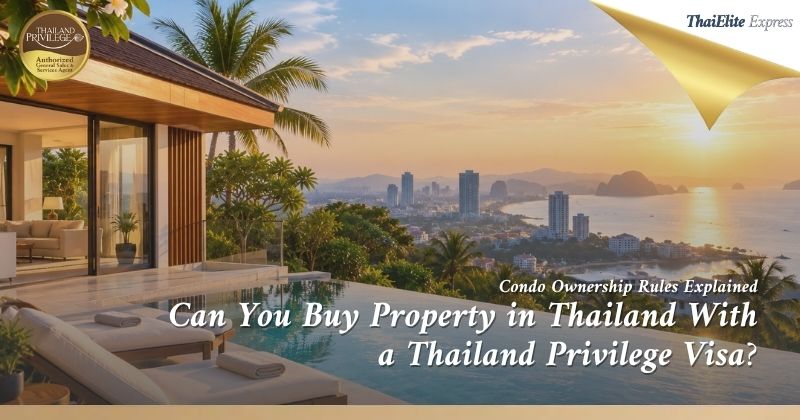
Yes, a foreigner can generally buy certain types of property in Thailand while holding a Thailand Privilege membership. However, Thailand Privilege does not give you special property ownership rights, and buying a property does not automatically grant you a long-term visa.
These are two separate decisions:
For many international buyers, combining a Thailand Privilege membership with a condominium purchase can be practical. The property provides a personal base, while Thailand Privilege can support a more predictable long-term stay strategy. But the two should be assessed independently before you commit funds.
Thailand Privilege, formerly known as Thailand Elite, is a long-term membership programme for eligible foreign nationals. Depending on the membership selected and the applicable terms, it may provide long-term entry privileges, airport assistance, concierge services and other lifestyle benefits.
It is not a property investment programme.
Holding Thailand Privilege does not automatically allow you to:
Likewise, owning a condominium does not automatically give you a Thailand Privilege membership or a right to remain in Thailand indefinitely.
This distinction is important because buyers sometimes assume that a high-value property purchase will solve their immigration needs. In Thailand, ownership of a home and permission to stay are generally treated as different legal questions.
In many cases, a foreigner can buy a condominium unit in Thailand in their own name as freehold, provided the purchase satisfies the relevant requirements.
The most important limitation is the foreign ownership quota. Under the general condominium framework, foreign ownership in a registered condominium project is commonly limited to 49% of the total saleable floor area. This is not simply a limit on the number of units. The calculation relates to the total saleable area owned by foreigners within the project.
Before signing a contract, a buyer should confirm:
The foreign quota can be close to full in popular buildings, particularly in central Bangkok, Phuket, Pattaya and other markets with substantial international demand. A unit may be advertised to foreign buyers but still be unavailable for foreign freehold registration if the quota has already been reached.
Our guide to Buying a Condo in Thailand explains the relationship between a condominium purchase and long-term stay planning in more detail.
Foreign condominium purchases commonly involve evidence that the purchase funds were transferred into Thailand from abroad in an acceptable form. The exact documentation can depend on the bank, the transaction structure and the registration requirements in force at the time of purchase.
This is one reason buyers should involve a Thai property lawyer and coordinate with the relevant bank before sending funds. A transfer that is not documented correctly can create problems at registration, even if the buyer has already signed a sale agreement.
The safest approach is to confirm the required payment route before making a deposit or transferring the balance.
Condominium ownership is generally more straightforward for foreigners than land ownership.
As a general rule, Thai land ownership is restricted for foreign individuals and foreign-controlled entities. There are limited exceptions and special approval routes, but these are subject to strict conditions and should not be treated as standard solutions for a residential buyer.
A foreigner may encounter other arrangements involving:
Each structure has different legal, financial and practical consequences. A lease is not the same as freehold ownership. Owning a building does not necessarily mean owning the land beneath it. A company structure may create tax, governance and compliance obligations and should not be used as a nominee arrangement to evade foreign ownership restrictions.
Buyers should also be cautious of claims that a Thai company can automatically be used to hold land for a foreigner. Nominee structures can expose all parties to serious legal and financial risks.
For most foreign individuals seeking a personal residence, the key initial question is whether a condominium can be purchased legally in foreign freehold quota. If not, the buyer should obtain independent advice before considering alternatives.
No. Buying property in Thailand does not automatically provide a long-term visa or permission to remain in the country.
A property owner must still comply with the immigration conditions attached to their current status. Depending on the person’s circumstances, possible long-stay routes may include Thailand Privilege, retirement-related options, family-based permission, business or employment-related permission, or other available programmes.
The requirements, validity periods and application procedures vary. Property ownership alone is not normally a substitute for these requirements.
You should also distinguish between:
Our overview of Thailand Long-Term Stay Options can help explain how property ownership fits into a broader immigration plan.
A buyer may choose both Thailand Privilege and property ownership because they solve different practical problems.
A condominium can provide:
Thailand Privilege may provide a separate immigration and service solution, depending on the selected membership and current terms. This can be useful for someone who wants to visit Thailand regularly without building their entire stay strategy around property ownership.
The combination may be attractive to a person who:
The important point is that Thailand Privilege is not necessary to buy a qualifying condominium, and buying a condominium is not necessary to apply for Thailand Privilege. The decision should be based on your actual use, travel pattern, financial objectives and preferred immigration route.
Membership terms and benefits can change. Review the current Pricing & Membership Tiers before making a decision.
Before committing to either a property purchase or a Thailand Privilege membership, work through the following questions.
Are you primarily looking for:
A property may be appropriate for accommodation but unsuitable as an investment. Thailand Privilege may be appropriate for long-term access but unrelated to your ownership objectives.
Do not rely only on an agent’s description. Confirm:
The ownership route should be confirmed before signing a binding agreement.
Ask how you will enter and remain in Thailand if the property purchase is delayed, sold or no longer suitable.
If your immigration plan depends entirely on owning a particular property, you may be exposed to unnecessary risk. A separate Thailand Privilege membership or another suitable long-stay route may provide more flexibility, but it should be assessed based on current eligibility and terms.
The purchase price is only one part of the financial decision. Consider:
A high-value property purchase and a long-term membership can both be substantial commitments. Compare the total cost over the period you expect to use them.
Use qualified advisers who are independent from the seller or developer where possible. A property lawyer can review title, contracts, quota and registration matters. An immigration specialist can explain Thailand Privilege eligibility, membership conditions and entry arrangements.
Neither adviser should be expected to replace the other.
A Singapore-based executive wants a two-bedroom condominium in Bangkok for personal use during business trips and holidays. She expects to visit Thailand six or seven times each year but does not plan to relocate permanently.
She may be able to purchase the condominium in foreign freehold quota, subject to due diligence and registration requirements. However, the purchase alone does not create a long-term stay solution.
If she wants more predictable access and concierge support, she could separately assess Thailand Privilege. The property would address accommodation, while the membership would address her immigration and travel-planning preferences.
A retiree from Europe wants to spend most of the year in Thailand and is considering a condominium in Chiang Mai or Phuket.
He should not assume that buying a condo replaces the requirements of a retirement-related immigration route. He may compare those requirements with Thailand Privilege, taking into account age, health insurance, financial documentation, travel frequency and desired membership duration.
The condominium may be suitable as a home, but the long-term stay plan should remain workable even if the purchase is delayed or the property is later sold.
An entrepreneur wants a Bangkok apartment while developing a business in Thailand.
Buying a condominium does not authorize him to work, manage a Thai business or provide services in Thailand. He must assess business registration, work authorization and immigration requirements separately.
Thailand Privilege may help with long-term entry and residence planning, but it should not be treated as a replacement for a work permit or business-specific permission where one is required.
A frequent visitor spends several weeks in Thailand every month and currently relies on hotels. She wants a condominium for convenience but does not intend to move permanently.
Ownership may reduce accommodation friction, but it does not automatically solve repeated-entry or long-stay issues. Thailand Privilege may be worth considering if its current benefits and membership period align with her travel pattern.
For this buyer, the main question is not whether property or membership is better. It is whether the two products work together within her budget and expected usage.
The appropriate membership depends on factors such as:
A buyer looking at higher-tier options should compare the current terms rather than choosing solely because of the property purchase. Review the details of Platinum and Diamond alongside other available options.
Membership benefits are separate from property rights. A higher membership tier does not normally change the legal rules governing condominium quotas or land ownership.
Yes, a Thailand Privilege member may generally buy a qualifying condominium subject to the same applicable ownership rules, foreign quota limits, payment requirements and registration procedures that apply to other foreign buyers.
Thailand Privilege does not automatically reserve a unit or expand the foreign ownership quota.
No. Thailand Privilege is not a land ownership programme. Foreign land ownership remains restricted and any exception or alternative structure must be assessed under the relevant Thai laws and regulations.
No. A condominium purchase does not automatically provide a visa or long-term immigration permission. The buyer must maintain a separate lawful basis for entering and staying in Thailand.
Property ownership does not generally prevent a person from applying, provided the applicant meets the current eligibility and screening requirements. Owning property is not normally a substitute for the application process.
Thailand Privilege should not be assumed to authorize employment or business activity. Work and professional activity may require separate permission, such as a work permit or another appropriate immigration arrangement.
Yes, independent legal advice is strongly recommended, particularly for title verification, foreign quota confirmation, contracts, funds-transfer documentation, taxes, registration and any leasehold or corporate structure.
The short answer is that Thailand Privilege members can generally consider buying a condominium in Thailand, provided the purchase complies with the applicable foreign ownership rules. But Thailand Privilege does not create special property rights, and property ownership does not automatically provide a long-term visa.
For many foreigners, the most practical approach is to treat the decision as two connected but separate workstreams:
ThaiElite Express can be a starting point for understanding the Thailand Privilege side of that decision, including available membership options and the application process. For property ownership, contracts, title checks, tax and registration, consult a qualified Thai property lawyer and other appropriate professional advisers before signing or transferring funds.
This article is general information only and is not legal, tax, immigration or investment advice. Thai property and immigration rules, fees and membership conditions can change. Confirm the current requirements with the relevant authorities and qualified advisers before making a decision.
Can Thailand Privilege members buy property in Thailand? Learn the rules for condo ownership, land restrictions and long-term stay planning.
Read MoreThailand continues to rank among the world’s most attractive destinations for international residents, retirees, and or families
Read MoreFor eligible members holding a valid Privilege Entry Visa (PE), Thailand generally grants permission to stay for up to one...
Read MoreThai Elite Express is operated by HLG (Thailand) Co., Ltd., a duly licensed General Sales Agent of the Thai Elite program and Thailand Privilege Card Co., Ltd. since 2013.