
A Thailand Privilege membership can be valid for 5, 10, 15, or 20 years. However, that does not mean the member receives one uninterrupted permission to stay in Thailand for the same number of years.
This is the most important distinction to understand before applying.
The membership period describes how long the selected Thailand Privilege package remains available, subject to the program’s terms. Your actual permission to stay is recorded by Thai immigration when you enter Thailand or receive an approved extension. For a holder of the Privilege Entry Visa (PE), Thailand Privilege currently states that permission to stay may be granted for up to one year per entry, subject to passport validity, visa validity, and the immigration record issued at the time of entry.
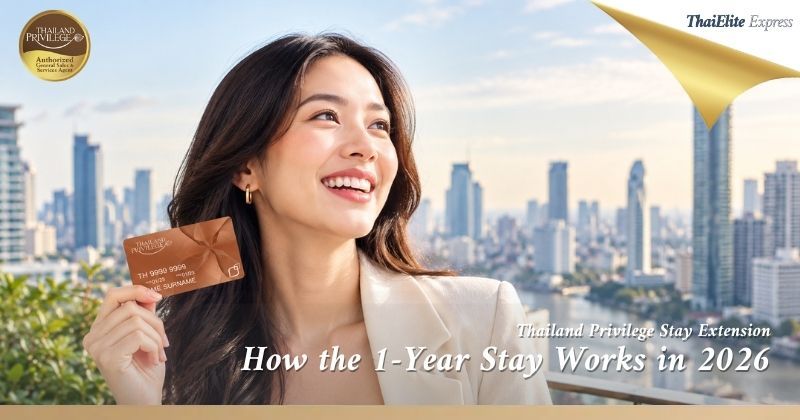
Here is how the Thailand Privilege stay extension process works in 2026.
Thailand Privilege packages are marketed according to their membership validity. The official Thailand Privilege website currently lists packages including:
| Membership | Published validity |
| Bronze | 5 years |
| Gold | 5 years |
| Platinum | 10 years |
| Diamond | 15 years |
| Reserve | 20 years |
These periods describe the membership. They do not represent one single immigration permission to remain in Thailand.
It is useful to separate the following terms:
| Term | What it means |
| Membership validity | How long your Thailand Privilege membership remains active |
| Visa validity | How long the relevant visa may be used, subject to its visa record |
| Permission to stay | The period granted by immigration after a particular entry or extension |
| Arrival stamp | The immigration record issued when you enter Thailand |
| Extension stamp | The record confirming an approved extension of your current stay |
| 90-day reporting | A separate reporting obligation for certain foreigners staying in Thailand for more than 90 consecutive days |
The Royal Thai Embassy in Kuala Lumpur’s visa information, updated in July 2026, lists the Privilege Entry Visa as a multiple-entry visa with five-year validity. It also notes that the period of stay may be subject to the discretion of the Thai immigration officer. The visa’s validity and your permitted stay are therefore related, but they are not identical concepts.
For a general comparison of current package periods and pricing, see the Thailand Privilege pricing and membership tiers.
No. A 5-year Thailand Privilege membership does not mean you can remain in Thailand continuously for five years under one entry or one permission-to-stay stamp.
A member holding a Privilege Entry Visa may generally receive permission to stay for up to one year per entry. Before that permission expires, the member must either apply for an appropriate extension or leave Thailand and later return under the applicable visa and immigration conditions.
The same principle applies to longer memberships. A 10-year, 15-year, or 20-year membership does not automatically create one uninterrupted stay for the entire membership period.
The one-year-per-entry concept applies to holders of the Privilege Entry Visa (PE). Thailand Privilege’s published guidance states that PE visa holders may receive permission to stay in Thailand for up to one year per visit.
The process works broadly as follows:
The phrase “up to one year” is important. Thailand Privilege states that the permitted period may be shorter if your passport or visa has less than one year of validity remaining. The actual date written or recorded by Thai immigration controls your individual case.
Always check the arrival stamp after entering Thailand. If the stamp appears to contain an error, Thailand Privilege advises members to notify immigration or the relevant assistance channel before leaving the airport and before the permitted stay expires.
A Thailand Privilege stay extension is an application to continue your current permission to stay beyond the date shown on your arrival stamp or previous extension stamp.
It is not the purchase of an additional membership year. It is also not the same as receiving a new entry stamp after travelling outside Thailand.
According to Thailand Privilege’s current stay-extension information:
An extension should never be treated as automatic or guaranteed. The immigration officer and the applicable rules determine the result.
Thailand Privilege currently lists documents that may include:
Requirements can change, and individual immigration offices may provide updated instructions. Confirm the current checklist before attending an appointment.
Do not use the membership end date as your only deadline. Instead, review the date on your latest arrival stamp or extension stamp.
A practical planning process is:
Look at the latest immigration stamp in your passport. This is the date that determines how long your current stay is permitted.
Thailand Privilege states that a PE stay may be shortened if the passport has less than one year of validity remaining. If your passport is close to expiry, clarify whether you should renew it before applying for an extension or planning your next entry.
Check whether your Privilege Entry Visa and membership remain valid for the action you intend to take. This is particularly important for members with longer memberships because the membership period and the visa validity shown on a particular visa record may not be identical.
If you plan to remain in Thailand, you may need to apply for a Thailand Privilege stay extension. If you plan to leave, check your documents and intended return date before departing.
Thailand Privilege states that members may apply up to 30 days before expiry. Starting early gives you time to identify missing documents or clarify instructions.
An overstay can create fines and other immigration consequences. Do not remain in Thailand after the date on your latest arrival or extension stamp without confirming the appropriate legal route.
An extension and a new entry are two different immigration events.
An extension allows you to seek additional permission to remain in Thailand without leaving the country. You apply through the relevant immigration process while your current permission is still valid.
When you leave Thailand, your current physical stay ends. A later return is a new entry. Before departure, confirm:
A multiple-entry visa does not mean that every future entry is guaranteed. The visa must be valid and usable, and admission and permission to stay remain subject to the immigration process at the time of entry.
This is why the phrase Thailand Elite stay extension can be misleading. “Thailand Elite” is the former name commonly used for the Thailand Privilege program, but an extension of stay is different from using the visa for a new entry.
Consider a member who holds a valid PE visa and enters Thailand on March 15, 2026.
This member may repeat the extension or entry process during the membership period, but each period is governed by the relevant immigration record. The member does not receive one single five-year permission to stay simply because the membership lasts five years.
Members should also distinguish between 90-day reporting and a Thailand Privilege stay extension.
A 90-day report is an address-reporting requirement that may apply when a foreigner remains in Thailand for more than 90 consecutive days. Completing a 90-day report does not extend the permitted stay.
For example, you could complete a 90-day report while still needing to apply for a stay extension before the expiry date shown on your passport stamp. These are separate administrative requirements with different purposes.
The right membership duration depends partly on how you plan to use Thailand.
Before choosing a package, consider:
For readers comparing entry-level options, the Thailand Privilege Bronze membership and Thailand Privilege Gold membership pages provide package-specific information. Those considering a longer-term commitment can review the Thailand Privilege Platinum membership.
The membership period may reduce the need to make a new long-term visa decision every few years, but it does not eliminate the need to monitor entry stamps, extensions, passport validity, and reporting obligations.
A PE visa holder may generally receive permission to stay for up to one year per entry. The actual period can be shorter if the passport or visa has less than one year of validity remaining. The immigration stamp controls the individual case.
No. The current Thailand Privilege guidance states that PE members receive a one-year extension with each application, but an application must still be made through the relevant process and remains subject to immigration approval and current requirements.
Thailand Privilege currently states that members may apply up to 30 days before the current permission expires. Confirm the current timing and document requirements before applying.
“Thailand Elite” is the former name commonly used for Thailand Privilege. In practical discussions, the terms may refer to the same general program, but the current terminology is Thailand Privilege and Privilege Entry Visa. The precise extension process depends on the visa and immigration record involved.
A PE visa is listed as multiple-entry, but re-entry is not a blanket guarantee. Check the validity of your visa, membership, passport, and any applicable requirements before travelling.
No. A 90-day report and a stay extension are separate processes. Completing one does not automatically complete the other.
No. ThaiElite Express can provide consultation, application support, and assistance with document preparation, but immigration authorities determine entry, permission to stay, and extension outcomes.
The simplest way to understand Thailand Privilege is to separate the long-term membership from the shorter immigration permissions used during that membership.
A 5-year membership does not mean a single 5-year stay. A PE visa holder may generally receive up to one year per entry, with the actual permitted period shown on the arrival stamp. If the member wants to remain longer, they must apply for a Thailand Privilege stay extension before the current permission expires. If they leave Thailand, their future stay will depend on the next entry and the documents valid at that time.
For a broader comparison of residency routes, see these Thailand long-term stay options.
Thailand Privilege’s 2026 structure and immigration procedures may change, and individual cases can depend on passport validity, visa records, travel history, and immigration decisions. If you are planning a long-term stay, discuss your intended travel pattern, passport situation, and preferred membership duration with ThaiElite Express before choosing a package.
The Thailand Privilege Card offers eligible foreign nationals a membership-based option for enjoying extended stays in Thailand, along with additional...
Read MoreIf you are considering a Thailand Privilege membership, one question can affect the value of the decision: is the membership...
Read MoreFor foreigners planning to spend many years in Thailand, the choice between Thailand Privilege or permanent residency is not simply...
Read MoreThai Elite Express is operated by HLG (Thailand) Co., Ltd., a duly licensed General Sales Agent of the Thai Elite program and Thailand Privilege Card Co., Ltd. since 2013.