
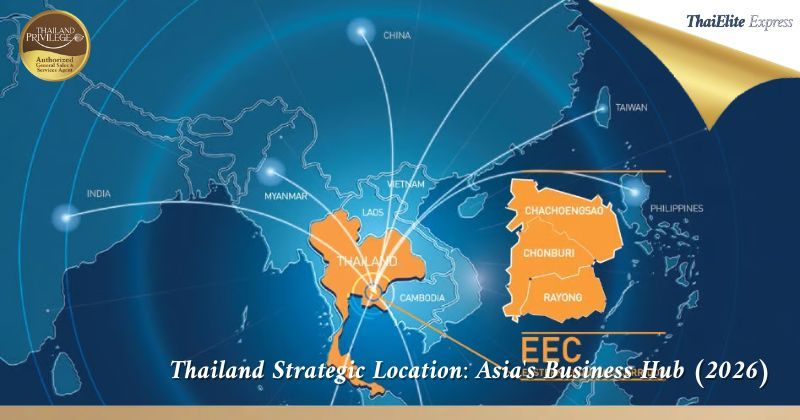
Thailand Strategic Location is one of the country’s greatest competitive advantages. Situated at the heart of Southeast Asia, Thailand enables entrepreneurs, investors, and globally mobile families to reach major consumer markets across ASEAN, China, India, and the Middle East with remarkable efficiency. For businesses looking to establish a regional base, Thailand’s strategic location combines geographic accessibility with world-class aviation, logistics, and long-term residency options.
Thailand sits in a rare position on the Asian map: close enough to major consumer markets for frequent, practical travel—yet stable and comfortable enough to operate from long term. For entrepreneurs, investors, and globally mobile families, that combination turns geography into a real business advantage.
The headline claim you may hear—“reach 2.5 billion consumers within three hours”—captures the idea, but the more defensible point is this: Thailand places you within short flights of ASEAN and within regional flight time of India, China, and Gulf hubs, supported by high-volume aviation and growing logistics infrastructure.
In an era of video calls, location still matters when you need to:
Thailand’s central position in mainland Southeast Asia makes it practical to cover multiple markets while keeping one main base—especially from Bangkok.
Thailand Strategic Location allows businesses to reach every major ASEAN economy efficiently. If your business touches Southeast Asia, Thailand is geographically “in the middle of the conversation.”
ASEAN (Association of Southeast Asian Nations) is not a small market cluster—it is a 684.1 million-person region (2024) according to ASEANStats. From Thailand, ASEAN is not an abstract concept; it is a short-haul operating zone.
Why that matters in practice:
If you’re building across ASEAN, your base is not just where you live—it’s where you can reliably depart from and return to multiple times per month.
One reason investors value Thailand Strategic Location is its proximity to southern China. China remains one of the world’s most important ecosystems for manufacturing, supply chains, and consumer growth. The World Bank’s Macro Poverty Outlook summary puts China’s population at 1,409.0 million (2024).
Thailand’s advantage is not that it “replaces” China. It’s that it offers a base close enough to maintain regular business travel, while operating from a location that is also highly connected to the rest of Asia.
Common entrepreneur use cases:
For many founders, the winning model isn’t picking one market—it’s building a travel pattern that makes two or three markets workable.
Thailand Strategic Location also supports growing trade and investment with India. India is increasingly central to technology, manufacturing, and global services. The World Bank Macro Poverty Outlook (April 2025) lists India’s population at 1,450.9 million (2024).
Thailand’s practical edge for India-linked entrepreneurs is that Bangkok can serve as:
Again, the point is not that India is “three hours away” from Thailand in every case. The point is that Thailand is positioned for repeat travel, which is what regional business actually requires.
Airlines and logistics networks strengthen Thailand Strategic Location for travel to the Middle East. The Middle East—especially Gulf hubs—often functions as a connector region for:
Bangkok’s connectivity to the Gulf is measurable.
For example, Emirates’ published schedules show Bangkok (BKK) to Dubai (DXB) flights with durations around 6 hours(commonly 6h05–6h15, flight-dependent). Qatar Airways also publishes frequent BKK–Doha schedules (daily services listed). Etihad notes up to three nonstop flights daily from Abu Dhabi to Bangkok (schedule-dependent).
So while the Middle East is not “next door,” Thailand is directly linked to it in a way that supports regional operations and global movement.
Modern airports reinforce Thailand Strategic Location as a regional gateway. Thailand’s geographic advantage only matters if you can actually move through it efficiently. That is where Bangkok’s aviation scale becomes important.
Thailand’s main aviation gateway is Suvarnabhumi Airport (BKK), supported by Don Mueang (DMK). Together they handle a very large share of Thailand’s air traffic.
In fiscal year 2024 (AOT airports):
That scale matters for entrepreneurs because higher passenger volume usually correlates with:
If your business involves time-sensitive goods (electronics, medical, luxury, high-value components), air cargo capacity matters.
Thailand BOI’s AOT summary shows:
Even if you never ship anything yourself, cargo volume is a sign of how “connected” an airport is to commercial routes.
Airports of Thailand notes that the SAT-1 (Satellite 1) terminal project aims to raise Suvarnabhumi’s passenger handling capacity from 45 million to 60 million passengers per year.
For a regional base strategy, that’s relevant because it indicates long-term commitment to keeping Bangkok viable as a high-volume hub—not just a tourist gateway.
Ports and highways further enhance Thailand Strategic Location for international trade. Entrepreneurs who trade physical goods care about more than flights. Thailand also has a major maritime and industrial logistics layer.
Laem Chabang is commonly cited as Thailand’s key deep-sea container port. Lloyd’s List reports 2024 throughput of 9,554,673 TEU (up 7.7% from 2023).
That’s the kind of scale that supports:
The Eastern Economic Corridor Office (EECO) describes Laem Chabang Phase 3 goals including capacity growth from 11 million TEUs to 18 million TEUs per year, and increasing the proportion of freight moved by rail (targeting a rise from 7% to 30%).
For a founder, this signals something specific: Thailand is positioning itself to move goods more efficiently—not only people.
When founders choose a base, they are usually optimizing for repeatability.
Thailand often works because it combines:
In short: Thailand reduces friction. And for entrepreneurs, friction is cost. Businesses expanding across Southeast Asia should also consider global mobility and international expansion strategies when choosing a regional headquarters.
Long-term residency options complement Thailand Strategic Location by making it easier for entrepreneurs and investors to establish a regional base. A regional base only works if you can stay long-term without constantly rebuilding your immigration status.
That’s where the Thailand Privilege Card (formerly Thailand Elite) is often considered by frequent travelers and long-stay residents. Thailand Privilege describes multiple membership tiers, including:
Important compliance note: Thailand Privilege content states membership is long-term visa status only and does not permit work or study under the membership.
Also, Thailand Privilege has announced a 50,000 THB membership application fee, deductible as part of the membership fee if the applicant is approved (per their announcement).
If your strategy is “base in Thailand and travel constantly,” the application process matters—especially documentation consistency and step-by-step sequencing.
ThaiElite Express states that it is:
We support applicants with:
We also communicate a pay-after-approval approach for the main membership fee (while applicants should still follow official program procedures, including any application-fee steps currently required).
The spirit of the claim is that Thailand is close to major Asian markets. However, India, China, and the Middle East are not uniformly within a three-hour flight window from Bangkok. A more accurate framing is that Thailand is within short flights of ASEAN and within regional flight time of India, China, and Gulf hubs.
ASEAN’s population is 684.1 million (2024), per ASEANStats.
In fiscal year 2024, Suvarnabhumi (BKK) handled 59,999,324 passengers and Don Mueang (DMK) handled 29,149,232, for 89,148,556 combined.
Yes. FY2024 cargo and postal volume at BKK was 1,332,093 tons (BOI summary of AOT airports).
Lloyd’s List reports Laem Chabang’s 2024 throughput at 9,554,673 TEU.
Bangkok has direct links to Gulf hubs. For example, Emirates schedules show BKK–DXB flights commonly around 6h05–6h15 (flight-dependent).
Thailand Privilege is the rebranded program (2023) offering long-stay membership tiers (5–20+ years depending on tier).
Thailand Privilege content states members are not permitted to work or study in Thailand under their membership status.
Thailand Privilege announced a 50,000 THB membership application fee, deductible from the membership fee if approved (per their announcement).
ThaiElite Express states it is an authorized GSSA and a subsidiary of Harvey Law Group Thailand, supporting consultation and application processing guidance for Thailand Privilege memberships.
Next step: If you’re considering Thailand as a regional base and want to understand which Thailand Privilege membership tier best matches your travel pattern, ThaiElite Express can walk you through options in a complimentary consultation.
The Thailand Privilege Card offers eligible foreign nationals a membership-based option for enjoying extended stays in Thailand, along with additional...
Read MoreIf you are considering a Thailand Privilege membership, one question can affect the value of the decision: is the membership...
Read MoreFor foreigners planning to spend many years in Thailand, the choice between Thailand Privilege or permanent residency is not simply...
Read MoreThai Elite Express is operated by HLG (Thailand) Co., Ltd., a duly licensed General Sales Agent of the Thai Elite program and Thailand Privilege Card Co., Ltd. since 2013.