
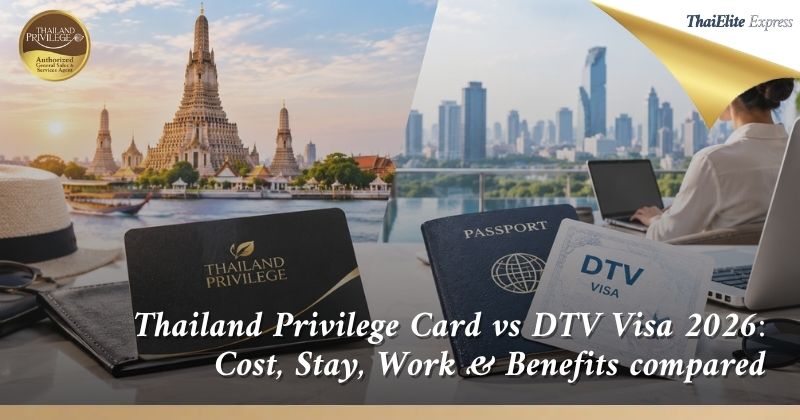
Thailand has two popular “long-stay” routes that attract very different types of residents: the Thailand Privilege Card (a paid membership program with immigration privileges and service benefits) and the DTV (Destination Thailand Visa)(a visa designed for longer stays, commonly associated with remote work and approved activities).
This guide compares them across eligibility, total cost, stay duration, renewals, flexibility, family options, airport services, and application complexity—so you can pick the best fit for how you actually live and travel in 2026. Rules and fees can change; always confirm the latest requirements before applying.
The Thailand Privilege Card (formerly Thailand Elite) is a membership program that grants qualifying foreigners a long-stay visa privilege plus bundled services (such as immigration facilitation and airport assistance) that vary by membership tier. You pay a membership fee, pass a background check, and then receive visa privileges tied to the program.
The DTV (Destination Thailand Visa) is a longer-stay visa that has been promoted for people who want to spend extended time in Thailand—commonly including remote workers/digital nomads and people joining certain Thai activities or programs. It generally relies on meeting documented eligibility criteria (such as financial evidence and proof of qualifying purpose) and does not come with VIP service bundles.
The tradeoff is straightforward: Privilege Card is a paid long-stay membership with services and long validity; DTV is a visa framework that can be cost-effective but is more document- and policy-dependent.
| Category | Thailand Privilege Card | DTV (Destination Thailand Visa) |
| Best for | Frequent travelers, retirees, families wanting long-term stability, people who value airport/admin support | Remote workers and long-stay visitors who qualify and want a lower-fee visa path |
| Eligibility (high level) | Pay membership fee + pass background checks; typical focus is admissibility, not employment/activity proof | Must meet visa criteria (often includes proof of qualifying purpose + financial evidence); document scrutiny can vary by location |
| Typical cost model | One-time membership fee (tier-based) + standard government/immigration fees as applicable | Visa fee + potential extension/administrative costs over time |
| Headline fees (typical published ranges) | Membership fees commonly start around THB 650,000 for 5 years, with longer tiers higher (e.g., 10–20 years) | Visa fee is typically far lower than Privilege; exact fee and any extension fees depend on current policy and where you apply |
| Stay duration | Long-stay visa privilege tied to membership (visa stickers/stamps issued per program rules) | Commonly structured as multi-year validitywith a limited stay per entry and possible extensions (confirm current DTV stay rules for 2026) |
| Renewals | Not an annual “visa renewal” in the normal sense; membership validity drives long-term stay privileges (you still follow immigration procedures) | Extensions/renewals depend on DTV policy and compliance; may require repeat documentation and/or fees |
| Flexibility for travel | Designed for people who enter/exit often; benefits and assistance can reduce friction | Generally flexible (often multi-entry), but you manage immigration steps yourself |
| Remote work suitability | Not a work permit; does not automatically authorize Thai employment. Remote work legality depends on your circumstances and current rules | Often positioned for remote work/long-stay profiles; still typically not Thai employment authorization. Confirm what is permitted in 2026 |
| Family inclusion | Family options exist in the Privilege ecosystem, but structure varies: either add-on options or separate memberships depending on tier and program rules | Dependent options may be possible, but typically require their own applications/fees and proof (confirm current dependent rules) |
| Airport services | Signature differentiator: airport meet-and-assist / fast-track-style service is commonly included (tier-dependent), sometimes with additional transport perks | Standard airport experience; no bundled fast track or concierge |
| Lifestyle benefits | Partner benefits and concierge-style services (tier- and points-dependent) | Not a benefits program |
| Application complexity | Often simpler for qualified applicants: background check + membership process; fewer “prove your work/activity” requirements | Document-heavy: must demonstrate eligibility; outcomes can vary by embassy/consulate and policy updates |
| If you want the simplest long-term life setup | Strong fit | Can be a fit if your documentation and profile cleanly meet requirements |
| If budget is the main driver | Usually higher total cost | Usually lower fee route if eligible |
If you’re leaning toward the Thailand Privilege Card: ThaiElite Express (an authorized GSSA) can confirm eligibility and guide the application through an online process: https://thaielite-express.com/
Thailand Privilege is mainly about admissibility and program acceptance, not proving a job type or Thai activity plan. In practice, eligibility is typically shaped by:
This route is commonly chosen by applicants who want a long stay without repeatedly re-proving income, employer letters, or program participation.
Common watch-outs
The DTV is typically aimed at people who can demonstrate a qualifying purpose and financial capacity. While exact rules must be confirmed for 2026, DTV eligibility commonly involves:
Common watch-outs
Privilege is best understood as a long-stay package: you pay a large upfront membership fee in exchange for multi-year stay privileges and service benefits.
Typical publicly discussed entry pricing starts around THB 650,000 for a 5-year membership, with higher tiers for longer durations (10–20 years) and more services. What you “get” depends on tier and program rules, but the cost is largely about:
This is why Privilege often appeals to people who value time, predictability, and friction reduction more than minimizing the visa fee.
DTV is typically far cheaper upfront than Privilege membership. But buyers should consider the “total cost of ownership,” including:
Privilege is designed as a long-term arrangement. Instead of thinking “How do I renew this visa every year?”, many members focus on:
In other words, the long-term “renewal risk” is generally lower because your stay privileges are tied to the membership validity rather than frequent visa re-qualification.
DTV is typically structured to allow longer stays, but the practical experience depends on:
For buyers, the key question is not just “How long is the visa valid?” but “How much admin will I do each year to keep living here the way I want?”
DTV is widely viewed as the Thailand long-stay visa option that most directly matches remote work / location-independent lifestyles—provided you can prove eligibility under the DTV criteria and you follow current conditions.
However, DTV is typically not the same thing as a Thai work permit. If your work involves Thai clients, a Thai employer, or activities considered local employment, you should get professional advice.
The Thailand Privilege Card is primarily a long-stay and service program. It may be suitable for remote workers who primarily want long-term stay convenience, but you should not assume it grants:
If you need to legally work for a Thai company, open a Thai payroll role, or run on-the-ground operations, you should consult a qualified professional about the correct business visa/work permit pathway.
Privilege can work well for families because it’s built for multi-year stability. Family handling depends on the membership tier and program rules, but the practical advantages are:
If your priority is “we want everyone set up for several years and we don’t want annual visa stress,” Privilege often becomes the clearer choice—even if it costs more.
DTV may allow dependent applications under current rules, but families should plan for:
For one person, DTV paperwork may feel manageable. For a family, the same workload multiplies quickly.
One of the most tangible benefits of the Thailand Privilege Card is airport support (commonly described as meet-and-assist and fast-track-style processing), typically offered by tier and subject to program conditions.
For people who:
this can be the deciding factor—because you experience it repeatedly, not once.
DTV holders typically use the standard immigration process at airports, with no bundled fast track or VIP arrival services. That’s not “bad,” but it’s not comparable to a membership program designed to include arrival assistance.
Privilege is not only about the visa privilege; it also includes a benefits system that can include:
The important buyer takeaway is that benefits vary. If you’re choosing Privilege partly for lifestyle perks, review the benefits for your specific tier and confirm what is currently offered.
DTV is a visa product, not a membership club. You should not expect:
If you want benefits, you’ll typically arrange them privately (paid concierge, lounge memberships, etc.).
Privilege applications generally follow a membership-style process:
Where ThaiElite Express fits
ThaiElite Express is an authorized General Sales & Services Agent (GSSA) for the Thailand Privilege Card. If you apply with ThaiElite Express, you can typically expect:
Start here: https://thaielite-express.com/
DTV is more like a classic visa application:
Most delays happen when documents are inconsistent (names, dates, employment status), or when the applicant’s situation doesn’t fit neatly into one eligibility box.
Pick the Thailand Privilege Card if you travel regularly and value time savings and predictability. The combination of long-stay structure plus airport assistance (tier-dependent) is hard to replicate with standard visas.
Start by evaluating DTV if you clearly meet the requirements and want a lower-fee option. Choose Privilege instead if your main priority is stability and convenience over proving eligibility repeatedly.
If you want multi-year certainty with minimal admin and you can afford the fee, the Thailand Privilege Card is often the cleaner lifestyle choice. DTV can work for some retirees depending on categories and documentation, but it’s usually not designed primarily for retirement planning.
Families typically benefit from stability and reduced paperwork, which favors the Thailand Privilege Card in many real-world cases. If you try to run a multi-person DTV strategy, the admin burden can rise quickly (documents, renewals, compliance steps).
If you only spend a few months in Thailand each year and don’t need airport handling, DTV (if you qualify) can be a cost-effective option. Privilege can still make sense if you strongly value VIP arrival support and want the ability to come and go for many years with minimal hassle.
The Thailand Privilege Card is usually the better match when you want a long runway (5–20 years depending on tier), service support, and fewer uncertainties around ongoing renewals. It’s essentially paying for certainty and time.
If you’re unsure: a quick eligibility and “best tier” assessment can prevent expensive missteps. ThaiElite Express can advise on the Thailand Privilege Card pathway here: https://thaielite-express.com/
Yes. The program has been commonly known as Thailand Elite in the past; it is now branded as Thailand Privilege. People still use “Elite” informally.
The Thailand Privilege Card is primarily a long-stay privilege and does not automatically grant a Thai work permit or authorize local employment. If you’re working remotely, you should ensure your activities comply with current Thai rules and get professional advice if your situation is complex.
DTV is often more aligned with remote-work-style stays and can be far cheaper. The Privilege Card can still be attractive to nomads who want long-term stability, frequent travel convenience, and bundled services—if the membership fee makes sense for their budget.
Airport assistance is one of the best-known Privilege benefits and is typically included depending on membership tier and current program conditions. Always confirm what your chosen tier includes before you pay.
Family arrangements depend on the tier and current program rules. In many cases, family members may need their own membership or a specific family option. For family planning, it’s important to confirm the exact structure for your chosen tier before applying.
DTV dependent options may exist under current rules, but requirements and fees can vary. Expect separate documentation for each dependent and confirm the exact dependent policy in effect in 2026 for your application location.
Timelines vary by applicant profile and program processing. Many applicants report outcomes in weeks rather than months, but there is no universal guarantee. If you want an updated estimate for your nationality and history, ThaiElite Express can check your case.
ThaiElite Express offers a pay-after-approval approach for the Thailand Privilege Card membership fee, meaning you generally pay after the application is approved (subject to the program’s process and terms).
In many real-world cases, yes—people change visas as their lifestyle changes. The key is timing: you must maintain lawful status and follow immigration procedures when transitioning. A consultation can help you plan the cleanest switch.
For most eligible applicants, DTV is cheaper in pure fees. The Thailand Privilege Card costs more because it bundles long-term certainty and services (like airport assistance and facilitation). “Cheaper” depends on what you value: visa fees alone, or total time/admin savings and bundled benefits.
Visa policies can change. Membership programs can also update benefits or conditions. The practical approach is to (1) confirm current rules right before applying and (2) choose the option that is least sensitive to changes for your lifestyle—often Privilege for long-term stability, DTV for cost if you can adapt.
ThaiElite Express is an Authorized General Sales & Services Agent (GSSA) for the Thailand Privilege Card and provides consultation and application support: https://thaielite-express.com/
There isn’t one best long-term visa for everyone.
If you’re leaning toward the Thailand Privilege Card and want help choosing the right tier and applying correctly, ThaiElite Express can guide you as an authorized GSSA—including a complimentary consultation and a pay-after-approval approach:
https://thaielite-express.com/
The Thailand Privilege Card offers eligible foreign nationals a membership-based option for enjoying extended stays in Thailand, along with additional...
Read MoreIf you are considering a Thailand Privilege membership, one question can affect the value of the decision: is the membership...
Read MoreFor foreigners planning to spend many years in Thailand, the choice between Thailand Privilege or permanent residency is not simply...
Read MoreThai Elite Express is operated by HLG (Thailand) Co., Ltd., a duly licensed General Sales Agent of the Thai Elite program and Thailand Privilege Card Co., Ltd. since 2013.