
Powered by HLG (Thailand)

Home - News - Thailand vs Singapore: Complete Guide for Long-Term Living (2026)

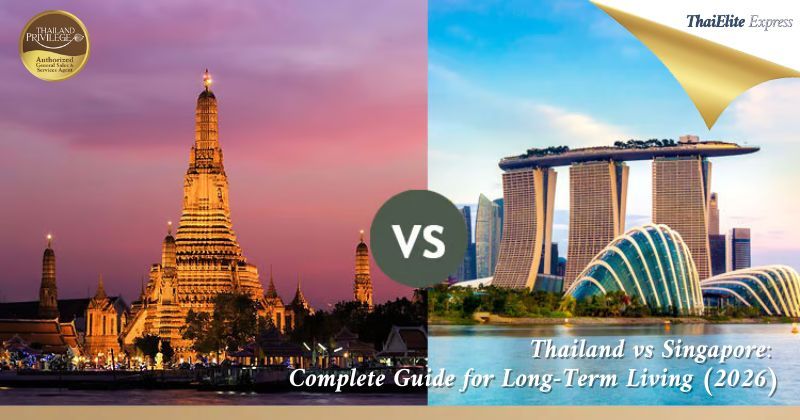
Thailand vs Singapore: Complete Guide for Long-Term Living (2026)

Thailand vs Singapore compared for long-term living. Explore costs, healthcare, taxes, property, residency, business, and lifestyle before you relocate.

“Better” depends on what you want from the next 1–10+ years—cost, comfort, taxes, business needs, and (often most importantly) residency certainty. Singapore is known for a highly structured, efficient city environment and strong institutions, but daily living and property entry costs can be high. Thailand offers broader lifestyle variety and often lower day-to-day expenses, plus long-stay visa pathways such as the Thailand Privilege Card—though it is not permanent residency and tax planning can be more situational.

This guide compares Thailand and Singapore across living cost, healthcare, property, taxes, lifestyle, business, and residency options. It stays neutral and does not declare an overall winner—because the right choice depends on your priorities and profile.

Quick comparison (at a glance)

Category Thailand Singapore
Living cost Often lower daily costs (housing, dining, services vary widely by city). Typically higher costs, especially housing and car ownership; strong currency impacts prices.
Healthcare Strong private hospital sector; quality varies by location; insurance important for foreigners. Highly regarded system with strong regulation and infrastructure; private care is costly but predictable.
Property Foreigners commonly buy condos (quota-based); land ownership is restricted and requires careful structuring/legal advice. Foreigners can buy many private condos but face high stamp duties; landed homes require approval.
Taxes PIT up to 35%; tax residency and foreign-income remittance rules matter significantly. PIT top marginal 24% for residents; no capital gains tax in most cases; territorial-style system.
Lifestyle Big range: Bangkok, beaches, mountains; more space and variety; slower pace possible. Dense global city: convenience, safety norms, strong public services; fast pace.
Business Growing ecosystem; can suit regional operators and lifestyle-led founders; compliance varies by sector. Strong global business hub; high competitiveness; clearer regulations and corporate infrastructure.
Residency options Multiple long-stay routes including Thailand Privilege Card (5–20 years) and LTR; not PR by default. Work passes and selective PR pathways; PR is a long-term goal but not guaranteed.

Living cost

Cost comparisons depend heavily on neighborhood, family size, and whether you choose a local or international lifestyle (international schools, imported groceries, serviced apartments, private insurance, etc.).

Singapore: where the budget usually goes

  • Housing is often the biggest line item (especially central areas or larger units).
  • Transport is efficient without a car, but car ownership is structurally expensive due to policy controls (avoid relying on driving unless you have the budget).
  • Consumption tax: Singapore’s GST is 9% (IRAS).
  • A useful benchmark: Singapore resident households spent an average of S$5,931/month on goods and services in 2023 (Singapore Department of Statistics).

Thailand: where the budget usually goes

  • Many foreigners find rent, dining, and services more affordable than in Singapore—especially outside prime Bangkok and resort hotspots.
  • Costs rise quickly with international schooling, premium neighborhoods, and imported goods.
  • Consumption tax: Thailand’s VAT is currently 7% (Thai Revenue Department).
  • A national benchmark: Thailand’s NSO reports average monthly household expenditure of 22,282 baht in 2024(National Statistical Office).

How to use this in decision-making:
If you want a predictable, high-convenience city and can accommodate higher fixed costs, Singapore can make sense. If you want more flexibility in lifestyle (and often lower day-to-day expenses), Thailand may be easier to tailor to different budgets—especially if you’re location-flexible.

Healthcare

Both countries have strong healthcare options, but the experience for foreigners depends on insurance, hospital choice, and whether you rely on public systems.

Singapore healthcare: what to expect

  • Singapore is widely known for high standards, strong regulation, and modern facilities.
  • Private care is accessible and efficient, but costs can be high without good coverage.
  • For many expats, the deciding factor is whether their employer coverage (or personal plan) is comprehensive enough for long-term needs.

Thailand healthcare: what to expect

  • Thailand has a large private hospital market, especially in Bangkok, with many internationally oriented providers.
  • Quality and English-language support can be excellent in major private hospitals, but it can vary more by city than in Singapore.
  • For long-term living, foreigners often plan around private insurance and proximity to their preferred hospital network.

Questions to ask before you move (either country):

  • Does your policy cover pre-existing conditions and chronic care?
  • Are maternity, mental health, and specialist care covered?
  • What is the hospital’s approach to cashless billing, deposits, and claims?

Property (renting and buying)

Housing is where Thailand vs Singapore often feels most different—both in cost and in legal structure.

Renting: common practical differences

  • Singapore rentals are generally well-organized, with clear contracts and professional management common in many buildings.
  • Thailand offers a wider range (condos, houses, serviced apartments) and pricing can vary dramatically by neighborhood and seasonality (especially in resort areas).

Buying property: foreign ownership realities

Singapore

  • Foreigners can buy many private apartments/condos, but purchase costs can rise sharply due to stamp duties.
  • Singapore’s Additional Buyer’s Stamp Duty (ABSD) can be significant: IRAS provides an example where a foreigner pays 60% ABSD on a purchase (IRAS).
  • For landed homes, non-citizens generally need approval: URA states that if you are not a Singapore citizen, you must obtain approval from the Controller of Residential Property in the Singapore Land Authority before you can buy landed houses (URA/SLA).

Thailand

  • Foreigners are commonly able to buy condominium units under specific conditions.
  • Thailand’s official government guidance notes that under the Condominium Act 1979, foreigners are permitted to own 49% of the total units in a condominium building (Thailand.go.th).
  • Buying land is a separate legal topic; rules and risk vary by structure. If land ownership matters to you, treat it as a specialist due diligence area.

Reality check (for both countries)

  • Property rules and taxes can change.
  • Financing availability can differ based on residency status and bank policies.
  • Get professional advice before committing to a purchase strategy.

Taxes

Taxes can be the most consequential long-term difference—especially if you have foreign income streams, investment income, or plan to remit funds across borders.

Important: This is a high-level comparison, not tax advice. Tax outcomes depend on residency status, income source, and double tax agreements (DTAs). Confirm with a qualified adviser.

Singapore taxes (high level)

  • Singapore resident personal income tax is progressive; the top marginal rate is 24% on chargeable income above S$1,000,000 (IRAS).
  • Non-resident employment income is taxed at 15% or resident rates (whichever higher); other income for non-residents is 24% (IRAS).
  • Singapore’s Ministry of Finance states Singapore does not have a capital gains tax (MOF).

Thailand taxes (high level)

  • Thailand personal income tax rates can reach 35% (Thai Revenue Department).
  • Tax residency is commonly referenced as more than 180 days in a calendar year (Thai Revenue Department).
  • A key point for long-term movers: Thailand has updated guidance affecting foreign-sourced income remitted into Thailand from 2024 onward. For example, professional tax summaries note that foreign-sourced income earned from 2024 and remitted in the same or later year may be taxable in Thailand, depending on circumstances and treaty positions (PwC Tax Summaries; also discussed by KPMG in relation to Por.161/2566).

How to use this in decision-making:

  • If you are a salaried employee in Singapore, Singapore’s system can be straightforward in practice.
  • If you are funding life in Thailand from overseas income or investments, you should plan carefully—especially around remittances and documentation.

Lifestyle (day-to-day living)

Lifestyle isn’t just “vibe”—it shapes your transport needs, your housing choices, your healthcare access, and how often you travel.

Thailand tends to suit people who want…

  • Variety: city life plus beaches and mountains in one country.
  • More living space and a broad range of housing styles.
  • A flexible pace—especially outside central Bangkok.

Singapore tends to suit people who want…

  • A compact, highly connected global city.
  • Very strong convenience: transport, administration, and services.
  • A predictable environment for families and professionals who prefer structure.

Family considerations

  • Both countries have international schools, but fees can materially affect budgets.
  • Consider commute time, childcare availability, and whether you want a single stable base (often easier in Singapore) versus lifestyle variety (often easier in Thailand).

Business (work, entrepreneurship, and connectivity)

Singapore: business environment strengths (general)

  • Singapore is frequently positioned as a regional HQ hub with strong institutions. Singapore EDB notes Singapore ranked 1st in the 2026 IMD World Competitiveness Ranking.
  • Work authorization is structured: for example, Singapore’s Ministry of Manpower lists Employment Pass qualifying salary requirements (MOM), and candidates typically must meet salary and evaluation criteria.

Thailand: business environment strengths (general)

  • Thailand can work well for founders or operators who want ASEAN access with lifestyle flexibility.
  • Competitiveness measures vary year to year; Thai press reporting indicates Thailand ranked 26th out of 70 in the IMD World Competitiveness Ranking 2026 (The Nation Thailand).

Mini-checklist if you run a cross-border business

  • Where is your primary client base?
  • Where is your banking and compliance easiest to maintain?
  • Do you need to hire locally (and sponsor work authorization)?
  • How will your tax residency interact with where profits are earned and remitted?

Residency options (most important decision section)

Residency is often the real “tie-breaker.” Singapore and Thailand offer very different models: Singapore is often about employment-led stays and selective PR pathways; Thailand offers multiple visa routes including long-stay memberships and long-term resident programs.

Singapore residency options (overview)

Common pathways (high level) include:

  • Work passes (e.g., Employment Pass) tied to employment conditions (MOM).
  • Dependent and family passes tied to the main pass holder.
  • Permanent Residence (PR): ICA lists eligibility categories (such as EP/S Pass holders, spouses/children of citizens/PRs, students meeting criteria, and investors via Global Investor Programme) and notes that assessment considers factors such as economic contribution, qualifications, age, and length of residency (ICA).

Expectation-setting:
PR is selective and outcomes vary. Singapore ICA also states it has no affiliation with external migration agencies claiming special partnership (ICA).

Thailand residency options (overview)

Common long-stay routes (depending on profile) include:

  • Retirement-style options (eligibility varies by age and financial requirements).
  • Business/work routes (often tied to work permit and company setup).
  • Thailand’s long-term programs such as LTR (Long-Term Resident) administered through BOI (BOI LTR).
  • Thailand Privilege Card (formerly Thailand Elite): a membership-based long-stay pathway.

Thailand Privilege Card (formerly Thailand Elite) — where it fits

Thailand Privilege is generally used by people who want multi-year stay certainty without frequent renewals, and who value immigration-related convenience services.

Membership tiers (official pricing and validity)

Thailand Privilege’s official site lists:

  • Bronze: THB 650,0005 years
  • Gold: THB 900,0005 years
  • Platinum: THB 1,500,00010 years
  • Diamond: THB 2,500,00015 years
  • Reserve: THB 5,000,00020 years (invite-only)
    (Thailand Privilege official site)

What the visa privilege looks like (official program documents)

Thailand Privilege membership agreements state the membership “will basically offer a 5-year multiple entry visa with extendable 1-year length of stay per each entry.” (Thailand Privilege membership agreement PDFs for Bronze/Gold)

What it is not

  • Not citizenship.
  • Not permanent residency by itself.
  • Not a work permit by itself (separate permissions may be required depending on what you do).

Where ThaiElite Express helps (factual)

ThaiElite Express provides consultation and application support for the Thailand Privilege Card, and states it is an authorized General Sales & Services Agent (GSSA) and a subsidiary of Harvey Law Group Thailand (ThaiElite Express). In practice, applicants typically use an authorized agent for help with tier selection, documentation, and coordination through the official process.

How to choose (neutral decision prompts)

Use these prompts as a simple decision tree:

  • Do you need Singapore PR as an end-goal, or is a long-stay visa/membership enough?
  • Is your income tied to Singapore employment, or will you fund life from overseas sources (tax planning becomes crucial)?
  • Do you plan to buy property soon (and can you accept Singapore’s stamp duties vs Thailand’s condo quota rules)?
  • Do you want a single global-city base (Singapore) or multiple lifestyle bases within one country (Thailand)?
  • Do you want a long-stay solution that reduces renewals (Thailand Privilege / LTR), or are you pursuing a work-led residency track (Singapore passes → PR possibility)?

Which is better for you? (profile-based guidance, no winner)

Retirees

Thailand may fit if: you want lifestyle variety, potentially lower daily costs, and long-stay options that don’t require frequent visa runs.
Singapore may fit if: you prioritize top-tier infrastructure, a highly structured environment, and don’t mind higher housing costs.
Watch-out: healthcare coverage and long-term budgeting (especially private care).

Digital nomads and remote workers

Thailand may fit if: you want flexibility across cities/islands and a longer-stay pathway (e.g., Thailand Privilege, depending on goals).
Singapore may fit if: you’re tied to Singapore-based employers, clients, or need a global business hub environment.
Watch-out: tax residency and how/where your income is considered sourced and remitted.

Families with school-age children

Thailand may fit if: you want more space and a broader housing range (especially outside prime areas), and you find the right schooling option.
Singapore may fit if: you want dense convenience, predictable systems, and easy commutes.
Watch-out: international school costs can be high in both countries.

Frequent business travelers

Thailand may fit if: your travel pattern benefits from Thailand Privilege services and you want a flexible base with multiple entry privileges.
Singapore may fit if: you need a consistently efficient hub for meetings, flights, and corporate governance.
Watch-out: residency permissions must match your travel frequency and work needs.

Entrepreneurs building in Southeast Asia

Thailand may fit if: you want a lifestyle-forward base and regional reach, especially if your operations don’t require Singapore’s regulatory ecosystem.
Singapore may fit if: you’re building a regulated, investor-facing or HQ-style structure and value global credibility and clarity.
Watch-out: compliance burden differs; don’t choose based on tax headlines alone.

Practical next steps (checklist)

  1. Define your residency goal: 1–3 years, 5–20 years, or PR target.
  2. Build a realistic monthly budget (housing, schooling, insurance, transport).
  3. Map healthcare needs and insurance coverage.
  4. Decide whether buying property is important—and what you’re legally able to buy.
  5. Get tax advice based on your income sources and where you’ll remit/spend.
  6. Shortlist residency pathways and create a document checklist.
  7. If considering the Thailand Privilege Card, request an eligibility and tier fit check.

If you’re exploring Thailand Privilege, ThaiElite Express can provide a complimentary consultation and guide you through the official application process (ThaiElite Express).

FAQ

1) Is Singapore more expensive than Thailand for long-term living?

In many expat budgets, Singapore often comes out higher, especially for housing and car ownership. Thailand can be more variable—Bangkok and resort areas can be expensive, while other cities may be significantly lower cost. Your lifestyle (schools, imports, private healthcare) often matters more than the country average.

2) Can foreigners access public healthcare in Singapore and Thailand?

Rules and costs vary by status and facility. Many foreigners in both countries rely heavily on private care and international insurance, especially for predictable access and English-language service.

3) Can foreigners buy property in Thailand or Singapore?

Yes, but under different rules. In Thailand, foreigners can own condominiums under quota-based rules (Thailand.go.th). In Singapore, foreigners can buy many private apartments/condos, but purchase taxes such as ABSD can be substantial (IRAS), and landed homes generally require approval (URA/SLA).

4) How do taxes differ for expats living in Thailand vs Singapore?

Singapore has progressive income tax with a top marginal rate of 24% for residents (IRAS) and generally no capital gains tax (MOF). Thailand’s PIT can reach 35% (Thai Revenue Department), and the treatment of foreign income remitted into Thailand is a key planning topic, especially for income earned from 2024 onward (PwC/KPMG summaries).

5) Is it easier to get long-term residency in Thailand or Singapore?

They are different systems. Singapore’s PR is selective and typically follows work and contribution pathways (ICA). Thailand offers multiple long-stay visa routes, including Thailand Privilege memberships and LTR, which can be more accessible for some profiles—but they are not the same as PR.

6) What is the Thailand Privilege Card (formerly Thailand Elite)?

It’s a long-stay membership program that provides immigration-related privileges and member services in Thailand. Thailand Privilege lists packages ranging from 5 to 20 years depending on tier (Thailand Privilege official site).

7) Does the Thailand Privilege Card give permanent residency or citizenship?

No. It provides a long-stay visa privilege and benefits, but it is not permanent residency or citizenship.

8) How long does a Thailand Privilege Card application take?

Timelines can vary based on background checks and documentation. Thailand Privilege describes an application process with approval and activation steps, but you should avoid relying on fixed timelines without confirmation for your case (Thailand Privilege).

9) What documents are usually needed for Thailand Privilege Card applications?

Requirements can vary by membership tier and your circumstances, but generally include passport and application materials, plus documents requested during review. An authorized agent can help ensure your submission is complete and consistent.

10) How does ThaiElite Express support Thailand Privilege Card applicants?

ThaiElite Express provides consultation, tier guidance, and application support through the official process. The company states it is an authorized GSSA and a subsidiary of Harvey Law Group Thailand (ThaiElite Express).

11) Can I work in Thailand if I have the Thailand Privilege Card?

The membership itself is not a work permit. Working legally typically requires the appropriate work authorization under Thai rules; confirm based on your intended activity.

12) Can families apply together for long-term stay in Thailand?

Some Thailand Privilege tiers and Thailand visa routes may accommodate family arrangements, but the structure depends on the specific program and each person’s status. Clarify whether family members need separate memberships or can be added under specific conditions.


Stay in Thailand long-term.
With a Privilege Entry Visa
that is valid from
5 years up to 20 years.

Contact us directly via WhatsApp

Share this article

Become an
Elite Member

NOW

Frequently asked questions

Who is eligible for Thai elite visa?
The applicant/the Member must have and maintain to have the following qualifications: Being allowed to stay in Thailand in accordance with the immigration laws or any related law of Thailand.(no overstay record) Holding foreign passport. Not having been sentenced by a judgment to imprisonment in any countries except for an offense committed through negligence. Not having been adjudicated bankrupt. Not having been declared as a person of unsound mind incompetence, or quasi incompetent.
How long can I stay in Thailand with Elite Visa?
Thailand Elite offer a 5,10 or 20 years membership and ensure the renewal of your visa during the validity of the membership. Each time a member goes through the Thai immigration, he/she will automatically get a one-year visa stamp in his/her passport until expiration of the membership. If the member happens to stay for more than 1-year consecutively in Thailand, then a simple renewal at the immigration office will grant another 1-year visa stamp.
Is Thailand Elite a scam?
The Thailand Elite Visa is a program initiated and approved by the Royal Thai government in 2003. The Thailand Privilege Card Co., Ltd, which runs the Elite Visa program is a fully owned subsidiary of the Tourism Authority of Thailand, under the Ministry of Tourism and Sport. ThaiElite-Express empowered by HLG Law Firm is an authorized sale agent.
Can I work with Thailand Elite?
After becoming an Elite member and obtaining your Thailand Elite Visa, you can apply anytime to a non-immigrant business visa and a work permit allowing you to work in Thailand. You also have the option of applying to the Elite Flexible Plus, invest at least 1 million USD in Thailand either in real estate, a limited or public company, or in stock exchange, and be granted a work permit.
How do I pay for Thailand Elite?
The payment is required only after submission of your application, the immigration background check by the Thai immigration, and receipt of the Approval Letter by email. Applicants could then choose to proceed to their membership fee by local or overseas bank transfer, credit card or depositing money to Thailand Elite bank account directly.
Is the Thailand Elite visa for Digital Nomads?
The Thailand Elite Visa is perfectly suitable for Digital Nomads. As business or retirement visas are not necessary a good match for digital nomads, the Elite Visa answers to all nomads with numerous privileges to cater members’ needs. With very little documentation needed, as well as the flexibility of applying from anywhere, regardless abroad, on arrival, or within Thailand. The process is seamless and fast. Moreover, from a study by The Instant Group, Bangkok has recently been voted as the world’s second-best city to work in as a digital nomad (best city in Asia). This is down to the innumerable benefits in which Bangkok brings, which are but not limited to; Internet broadband speed, culture, scenery, transportation, weather, affordability, cuisine, and more. Having already welcomed 35 million digital nomads from all over the world, in 2021, it’s forecasted that there would be more arrivals to the Land of Smiles with constant technological and infrastructure improvements.
What is the long term visa available in Thailand?
Applying to a Thailand Elite program is a viable and easy solution to stay and live for a long period of time in Thailand. Only Thailand Elite can offer a 5,10 or 20 years membership and ensure the renewal of the visa during the validity of the applicant membership. As of today, all other non-immigrant visa options are limited to a validity period of 1 or 2 years.
Thailand elite vs Retirement Visa
To retire in Thailand, the Elite Visa is a worry-free option compared to the Retirement Visa from the application, during holding period to the renewable. At the application time, for an Elite, the documentation is minimal, and no medical insurance nor proof of funds is required for instance. During the holding period, Elite members enjoy numerous privileges such as an assistance for their 90 days report, a fast track at the airport immigration, the lounge access and airport limousine, assistance in opening a bank account in local or foreign currency, a 24/7 call center and much more. The Elite Visa offers you an easy renewable of the Privilege Entry Visa for the duration of your membership.
What is the long term visa available in Thailand?
Applying to a Thailand Elite program is a viable and easy solution to stay and live for a long period of time in Thailand. Only Thailand Elite can offer a 5,10 or 20 years membership and ensure the renewal of the visa during the validity of the applicant membership. As of today, all other non-immigrant visa options are limited to a validity period of 1 or 2 years.
Is the Thailand Elite Visa legit?
The Thailand Elite Visa is a legal and legit program under Thai law to stay long-term in Thailand. The “Thailand Elite” is operated by Thailand Privilege Card Co., Ltd. It has been initiated in 2003 by the Royal Thai Government itself. The company is fully owned subsidiary of the Tourism Authority of Thailand, under the Ministry of Tourism and Sport.

Related Articles

Thailand vs Singapore: Complete Guide for Long-Term Living (2026)

August 22, 2026

Compare Thailand vs Singapore across living costs, healthcare, property, taxes, business, and residency to determine which destination best suits your...

Read More

Doing Business in Thailand: Why Global Companies Choose Bangkok

August 20, 2026

Learn why global companies choose Bangkok for doing business in Thailand, from BOI incentives and logistics to talent, infrastructure, and...

Read More

Thailand Tax Advantages Explained (2026 Guide)

August 18, 2026

Understand Thailand's tax advantages, tax residency rules, foreign income taxation, and Double Tax Agreements before relocating or retiring in Thailand.

Read More

Our qualified team will contact you within today.

Thailand Privilege Card representative will contact you shortly with more information.

Our qualified team will contact you within today.

Thailand Privilege Card representative will contact you shortly with more information.