
If you’re in Thailand on a tourist entry (visa exemption/TR) or a retirement status and you want a longer-term, lower-maintenance way to stay, the Thailand Privilege Visa can be a strong alternative. This guide explains what “switching” really means in practice, what you can usually do while staying in Thailand, how to plan your timeline to avoid overstays, typical steps and documents, and the most common mistakes people make during the transition.
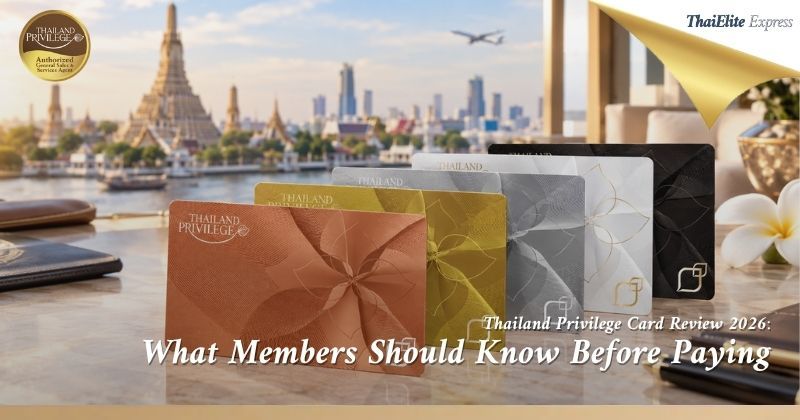
The Thailand Privilege Card (formerly known as Thailand Elite) is a government-backed membership program operated by Thailand Privilege Card Co., Ltd. Once approved as a member, you become eligible to receive a Thailand Privilege visa,most commonly the Privilege Entry Visa (PE).
Two key points that reduce confusion:
Because your day-to-day status depends on the entry stamp, getting the affixation timing right is the most important part of a “switch.”
Internal link suggestion: Thailand Privilege membership tiers (ThaiElite Express)
In many cases, yes, you can start (and often complete) the Thailand Privilege process while you are physically in Thailand, even if you entered on visa exemption or a Tourist Visa (TR). However, the outcome depends on one non-negotiable requirement:
Thailand Privilege membership approval and visa affixation take time. If your permission to stay expires during processing, you risk overstay,which can trigger fines, bans, or complications with visa issuance.
Thailand Privilege’s own overstay guidance highlights serious consequences for overstaying, including fines and re-entry bans depending on length of overstay. Treat your current permitted-to-stay date as your fixed deadline and build a realistic buffer.
Yes, retirees commonly move from retirement-based status to Thailand Privilege, especially if they want to reduce annual renewals and financial-document burdens.
That said, “switching” from retirement status is still a timing exercise:
If your retirement setup is already stable, switching can still make sense,just don’t assume it will happen instantly. The cleanest transitions are the ones planned months (or at least several weeks) in advance.
Here’s a neutral, high-level comparison to help you choose the right tool for your situation.
| Topic | Tourist / Visa Exemption | Retirement (Non-O / O-A / O-X) | Thailand Privilege (PE/SE via membership) |
| Typical use case | Short stays, travel | Long stays for age 50+ (varies by subtype) | Long-term base with membership privileges |
| Paperwork intensity over time | Repeated extensions/entries | Ongoing compliance and renewals | Membership approval + visa affixation; ongoing immigration compliance |
| Financial proof | Often basic (varies) | Often significant (e.g., 800,000 THB balance or income thresholds; plus additional requirements for O-A/O-X) | Membership fee replaces retirement-style financial proof requirements |
| Permission to stay | Depends on entry/visa | Commonly 1 year extensions (varies) | PE commonly up to 1 year per entry(check stamp each entry) |
| 90-day reporting | Applies if staying 90+ days continuously | Generally applies if staying 90+ days continuously | Applies if staying 90+ days continuously; Thailand Privilege states fine for missing can be THB 2,000 |
| Work permission | Not granted | Not automatically granted | Not a work-authorizing status by itself; separate permissions required |
If your main goal is long-term stay with fewer renewals and added concierge benefits, Thailand Privilege can be a fit. If you’re budget-focused or only need short stays, a tourist path may be more practical.
Below is the typical, real-world pathway most applicants follow.
Thailand Privilege offers multiple tiers (commonly 5–20 years). Your choice affects membership duration, included services, and cost.
A practical way to decide:
Internal link suggestion: Compare Thailand Privilege packages (ThaiElite Express)
Exact requirements can vary by applicant and screening, but commonly requested items include:
A key item referenced in official materials is the Certification Letter issued by Thailand Privilege Card, used for the visa process and typically valid for a limited period.
You submit your application for screening/background check. At ThaiElite Express, this is typically handled through an online portal with document review and consultation support.
A commonly cited range for screening is around 4–6 weeks on average (not guaranteed). Some cases may take longer depending on personal history and verification needs.
If you’re on a tourist entry, this is where most timeline problems happen: your stay clock keeps running while you wait.
Thailand Privilege processes generally require payment after approval, and instructions typically provide a deadline to complete payment.
ThaiElite Express follows a pay-after-approval approach, meaning you don’t pay the main membership fee upfront before you know the outcome of screening.
Affixation is the step where the Thailand Privilege visa is placed into your passport. Common affixation routes include:
This is why “switching” isn’t just an application,it’s an application plus a correctly-timed affixation plan.
Thailand Privilege members still need to follow standard immigration compliance rules, including:
The safest approach is to plan backwards from your current permitted-to-stay date.
If you are on a tourist entry, aim to begin the process at least 6–8 weeks before your current permission to stay ends. This aligns with widely cited screening timelines (often 4–6 weeks) plus buffer time for payment, issuing documents, and affixation scheduling.
Let’s say your permitted-to-stay date ends on 30 June:
If you’re already inside the final few weeks of your stay, get advice immediately,because the correct solution depends on your exact entry type, remaining days, and the available affixation route.
Thailand Privilege is membership-based, meaning the main cost is the membership fee for the tier you choose.
Official program materials list these headline fees:
Other costs to plan for may include:
Because promotions and package availability can change, confirm current pricing and conditions before you commit.
ThaiElite Express supports clients who want to move from tourist or retirement status into Thailand Privilege by focusing on two things: accuracy and timing.
What we provide:
If you’re close to your permitted-to-stay date, the most valuable first step is a timeline check,so you know what is realistically achievable before your current stay expires.
Internal link suggestion: Request a complimentary Thailand Privilege consultation (ThaiElite Express)
In many cases, yes,you can submit the membership application while in Thailand. The key is to remain in lawful status until the Privilege visa is affixed and activated.
Not always. Affixation can often be done through in-country procedures (commonly referenced at Chaeng Wattana) or via airport/embassy routes. The best option depends on your current status, timing, and operational procedure at the time.
Timelines vary. A commonly cited average is around 4–6 weeks for background screening, but it is not guaranteed and can take longer in some cases.
You must avoid overstaying. If approval will not arrive in time, you may need a lawful bridging plan (such as an extension where eligible or travel planning). Get advice early, waiting until the last week is risky.
Many do. Keeping your current retirement status active until your Privilege visa is fully affixed can help prevent gaps in lawful stay.
Thailand Privilege is not a work-authorizing status by itself. If you plan to work, you must follow the appropriate legal process for work authorization (as applicable to your situation).
Certain tiers allow family members to join via add-on/supplementary membership options, subject to program rules and supporting relationship documents. Confirm current options before applying.
Typically: passport biodata page, recent photo, application forms, and,if you’re in Thailand,copies of your current visa pages and entry stamps. Additional documents may be requested depending on your profile.
ThaiElite Express operates as an authorized General Sales & Services Agent (GSSA) supporting Thailand Privilege Card applications, and is a subsidiary of HLG Thailand.
Generally, the main membership fee is paid after approval (pay-after-approval approach), following the official payment instructions and deadline issued upon approval.
Yes, if you stay in Thailand for more than 90 consecutive days, reporting requirements apply. Thailand Privilege notes that missing the report can result in a THB 2,000 fine.
Yes,the program was previously branded as Thailand Elite. Today it is commonly referred to as the Thailand Privilege Card.
If you want help planning the cleanest timeline from your current tourist or retirement status into Thailand Privilege, ThaiElite Express can review your dates and recommend the safest path before you run into a deadline.
Internal link suggestion: Contact ThaiElite Express (24/7 support)
If you know someone who may be interested in staying in Thailand long term, you may be able to refer...
Read MoreThailand Privilege Card review 2026 covering costs, key benefits, limitations, membership value, who it suits, and what to consider before...
Read MoreAmericans can apply for the Thailand Privilege Card (formerly Thailand Elite), and many US citizens use it as a straightforward...
Read MoreThai Elite Express is operated by HLG (Thailand) Co., Ltd., a duly licensed General Sales Agent of the Thai Elite program and Thailand Privilege Card Co., Ltd. since 2013.