Thailand offers several legal ways to live here long term—but the “right” option depends on your age, whether you need to work, your income/asset profile, and how often you want to renew. This guide breaks down the five most common long-stay routes in 2026 and shows you how to choose quickly.
The 2‑minute answer (most people can decide from this)
If you want to stay in Thailand long term, here’s the simplest way to choose:
- Want 5–20 years with minimal renewals and no income/age requirements? → Thailand Privilege Card (Thailand Privilege Visa; formerly Thailand Elite). You pay a one‑time membership fee and receive long‑stay visa privileges (work permission is not included).
- High income / high net worth / want a 10‑year framework and the option to work legally? → LTR Visa (Long‑Term Resident) via Thailand BOI.
- Age 50+ and not planning to work? → Retirement visa (commonly Non‑Immigrant O‑A / retirement extensions).
- Remote worker/freelancer for overseas clients and want a lower-fee long‑stay “workcation” style visa? → DTV (Destination Thailand Visa).
- Working for a Thai employer or running Thai business activities that require local authorization? → Non‑Immigrant B (Business/Work) + a proper work permit.
Rules and documents can change by embassy and immigration office—always check official sources before applying.
Quick decision flow (choose your path in 30 seconds)
Start here:
- Are you taking a job in Thailand (Thai employer) or need Thai work authorization?
→ Yes: Non‑Immigrant B (see Option 5)
- Are you 50+ and retiring (no work in Thailand)?
→ Yes: Retirement visa (see Option 3)
- Do you qualify as high‑income/high‑net‑worth and want a 10‑year visa with structured privileges?
→ Yes: LTR Visa (see Option 2)
- Do you want the fewest renewals and are okay paying a one‑time membership fee?
→ Yes: Thailand Privilege Card (see Option 1)
- Are you a remote worker/freelancer working for companies/clients outside Thailand?
→ Yes: DTV (see Option 4)
Option 1: Thailand Privilege Card (5–20 years)
Thailand Privilege Card (often still called “Thailand Elite”) is a paid long‑stay membership program that grants visa privileges designed to make living in Thailand long term more predictable—especially if you don’t want annual renewals.
Eligibility
Typical requirements are straightforward:
- Valid passport
- Background check / eligibility screening
- No minimum age or income requirement (membership-fee based program)
Fees
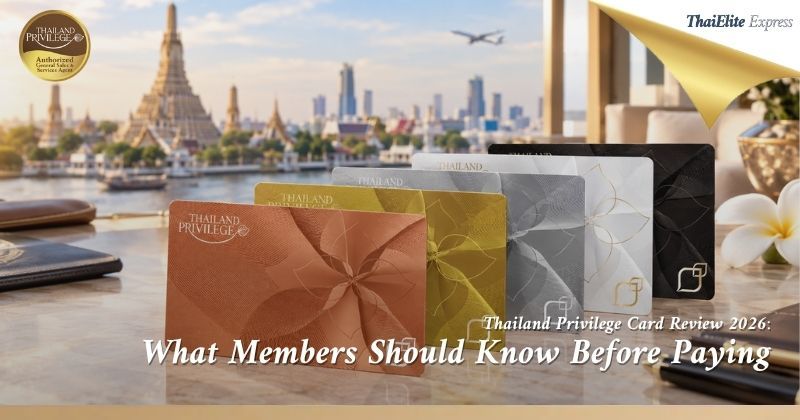
Published membership fees (one‑time, by tier):
- Bronze: THB 650,000 (5 years)
- Gold: THB 900,000 (5 years)
- Platinum: THB 1,500,000 (10 years)
- Diamond: THB 2,500,000 (15 years)
- Reserve (invitation only): THB 5,000,000 (20 years)
Process
- Choose a membership tier
- Submit application + passport copy and required forms
- Background check / screening
- Receive approval notice
- Pay after approval to the official Thailand Privilege account (per instructions)
- Visa issuance/affixation and membership activation
Timeline
Approval times vary by nationality and screening workload. Many applicants plan for several weeks end-to-end (avoid promising a fixed number of days).
Best for
- Frequent visitors who want fewer renewals
- Under‑50 retirees and lifestyle migrants who don’t qualify for retirement visas
- Families and business travelers who value immigration convenience
- Anyone who wants long-term stay stability without proving income
Key limits / watch‑outs
- Not a work permit: you still need proper authorization to work in Thailand
- Not permanent residence or citizenship
- 90‑day reporting rules can still apply if you stay continuously in Thailand
- Benefits and privileges can be updated by the program over time
Applying through ThaiElite Express (short note)
ThaiElite Express is an authorized GSSA with an online application portal and consultation support. You pay only after approval and the payment goes to the official Thailand Privilege account.
Option 2: LTR Visa (Long‑Term Resident) — 10‑year framework
The LTR Visa is designed for “high‑potential foreigners” and is administered through Thailand’s Board of Investment (BOI) system. It’s a strong fit if you can meet higher thresholds and want a structured 10‑year pathway with privileges (and, depending on category, work authorization).
Eligibility
LTR has four main categories:
- Wealthy Global Citizens
- Wealthy Pensioners
- Work‑from‑Thailand Professionals
- Highly‑Skilled Professionals
Important: criteria were updated (BOI 2025 update). For example, Wealthy Global Citizen now emphasizes assets + Thai investment (not necessarily personal income).
Fees
- Visa issuance fee: THB 50,000 per person (when issued in Thailand via TIESC).
Embassy e‑visa issuance fees can vary by currency/exchange rates.
Process
- Apply online through the BOI LTR system (qualification endorsement)
- Upload supporting documents and respond to any additional document requests
- If endorsed, proceed to visa issuance within the required timeframe (often within 60 days of endorsement letter)
- Visa is issued in Thailand (TIESC/Immigration) or via an embassy/consulate e‑visa route
Timeline
around 20 working days once documents are complete (not a guarantee).
Best for
- High‑income remote professionals who qualify under BOI rules
- High‑net‑worth individuals who can meet asset + investment thresholds
- Executives/specialists in targeted industries
- People who want a longer-term framework with fewer reporting burdens
Key limits / watch‑outs
- Higher documentation burden than other options
- Health insurance/financial security requirements apply
- Criteria and evidence standards are strict; incomplete applications cause delays
Option 3: Thailand Retirement Visa (age 50+)
If you’re 50 or older and don’t need to work in Thailand, retirement routes are often the lowest-cost long-stay approach—but they usually require annual renewals and meeting ongoing financial criteria.
Eligibility
Common baseline requirements:
- Age 50+
- Financial evidence typically based on one of these:
- THB 800,000 in a Thai bank account, or
- THB 65,000/month income, or
- Combination meeting the required total
- Valid passport
- Additional embassy/immigration document requirements can apply (police/medical certificates, insurance depending on visa type and embassy)
Fees
Costs depend on the exact route (visa vs extension). Common government fees include:
- Visa application fees (varies by visa type/embassy)
- Extensions of stay and re-entry permits (if needed)
Process
- Apply via Thai embassy/consulate (or enter and apply for an extension route where eligible)
- Show required financial evidence and supporting documents
- Receive initial stay permission
- Renew/extend annually (and comply with reporting requirements)
Timeline
Varies widely by embassy/office and completeness of documents.
Best for
- Retirees 50+ with stable savings or pension income
- People comfortable with yearly renewals and ongoing compliance
Key limits / watch‑outs
- Generally no work permitted
- Reporting obligations (including 90‑day reporting if staying continuously)
- Financial evidence must be maintained in the required manner
Option 4: Destination Thailand Visa (DTV) — remote work / workcation route
The DTV is designed for people who want to stay longer in Thailand while working remotely for overseas employers/clients (and for certain “Thai soft power” activity categories). It’s often described as a 5‑year multiple‑entry visa with 180 days permitted stay per entry.
Eligibility
Common requirements include:
- Proof of remote work/freelance status (overseas) or qualifying activity proof
- Proof of funds (often shown as THB 500,000 in financial evidence in embassy checklists)
- Passport and standard application documents
Fees
- DTV visa fee is commonly listed by embassies as 10,000 baht (or local-currency equivalent).
Process
- Apply via Thai embassy/consulate (often through Thai e‑Visa, depending on location)
- Upload financial evidence + remote work/activity evidence
- Receive e‑visa approval and enter Thailand
- Manage your stay per-entry rules (and any extension rules at immigration)
Timeline
Embassy processing times vary.
Best for
- Digital nomads / remote employees working for non‑Thai companies
- Freelancers with overseas clients
- People who want a lower-fee alternative to membership programs
Key limits / watch‑outs
- DTV is not the same as Thai employment authorization—Thai local work generally requires proper work status
- Stay structure is per entry (commonly 180 days) rather than “5 years continuous”
- Bank account opening can depend on bank policy and documentation—avoid assuming a blanket rule
Option 5: Non‑Immigrant B (Business/Work Visa) + work permit path
If you will work in Thailand (Thai employer) or conduct business activities that require local authorization, the standard route is Non‑Immigrant B plus a compliant work permit process.
Eligibility
Common requirements include:
- Thai employer sponsorship / company documents
- Proper role and supporting paperwork
- Passport and application forms
- Work permit required before starting work (visa alone doesn’t authorize work)
Fees
MoFA lists:
- THB 2,000 (single entry)
- THB 5,000 (multiple entry)
Process
- Obtain Non‑Immigrant B entry visa (embassy/consulate)
- Enter Thailand and proceed with work permit steps (through employer)
- Extend stay based on employment documentation and compliance
Timeline
Varies by employer readiness, document completeness, and local office workload.
Best for
- Foreign employees of Thai companies
- People who need explicit work authorization in Thailand
Key limits / watch‑outs
- Compliance is document-heavy
- Employer obligations matter (not just the individual)
- Extensions are tied to ongoing employment and proper filings
Quick comparison table (2026 snapshot)
| Option |
Typical “long-stay shape” |
Upfront cost |
Work rights in Thailand? |
Best for |
| Thailand Privilege Card |
5–20 years membership; long-stay visa privileges |
THB 650,000–5,000,000 |
No (not by itself) |
Minimal renewals; convenience |
| LTR Visa |
10-year framework (issued in 5+5 years) |
THB 50,000 (issuance fee) |
Yes (category-dependent) |
HNW / high-income / specialists |
| Retirement |
1-year renewable |
Lower fees, ongoing proof |
No |
50+ retirees |
| DTV |
5-year multiple-entry; typically 180 days per entry |
~10,000 THB |
Remote work only (not Thai employment) |
Remote workers/freelancers |
| Non‑Immigrant B |
Often starts 90 days, extendable to 1 year |
Varies (visa + permits) |
Yes (with work permit) |
Thai employment |
Common requirements and practical reminders (don’t skip these)
- Overstay is costly: fines and possible bans—always track your permitted stay date.
- 90‑day reporting: many long-stay statuses require address reporting if you remain in Thailand continuously.
- Extensions and re-entry: some visas require re-entry permits to keep your status when leaving—know your category’s rules.
- Embassy vs immigration: “visa validity” and “permitted stay” are not the same thing—your entry stamp controls your allowed stay.
FAQ
How do I stay in Thailand long term legally?
Pick a visa route that matches your profile (Privilege, LTR, retirement, DTV, or Non‑B) and apply through official channels (Thai e‑Visa / BOI / embassy / immigration). Avoid stacking tourist entries as a “plan.”
What is the easiest way to stay in Thailand for several years?
For many people who don’t qualify for retirement or LTR, the Thailand Privilege Card is the most straightforward multi‑year option because it’s membership-based (no income/age requirement) and designed for long stays.
Is Thailand Privilege Card the same as Thailand Elite?
Thailand Privilege Card is the program commonly known historically as Thailand Elite. Many people still use the old name.
Can I work in Thailand on a long‑stay option?
- Non‑Immigrant B + work permit is the standard employment route.
- LTR can allow work (depending on category).
- Thailand Privilege Card and retirement routes do not grant work permission by themselves.
Where do I apply for a Thailand long‑stay visa?
- Many visas are applied for via Thai e‑Visa (outside Thailand).
- LTR is via BOI’s LTR system.
- Thailand Privilege Card is via Thailand Privilege (directly or via an authorized GSSA).
See the “Where to apply” section above for official links.
How long does Thailand Privilege approval take?
It varies based on screening workload and nationality. Plan for several weeks and avoid booking immovable travel until you have written approval.
Do you help with Thailand Privilege Card applications?
Yes—ThaiElite Express supports Thailand Privilege applications as an authorized GSSA, including document guidance and application tracking. Payment is made after approval and paid to the official Thailand Privilege account per their instructions.
What documents do I typically need?
Most long-stay applications require:
- Passport biodata page
- Photos (per embassy specs)
- Proof of funds/income (for retirement/LTR/DTV)
- Employment/company documents (Non‑B / some LTR categories)
- Background check/police certificate or medical/insurance documents in some categories (varies)
Next step (practical)
If you already know which route fits, start at the official application portal (Thai e‑Visa / BOI LTR / Thailand Privilege). If you’re leaning toward the Thailand Privilege Card, ThaiElite Express can help you confirm the correct tier and prepare an application checklist before submission.