
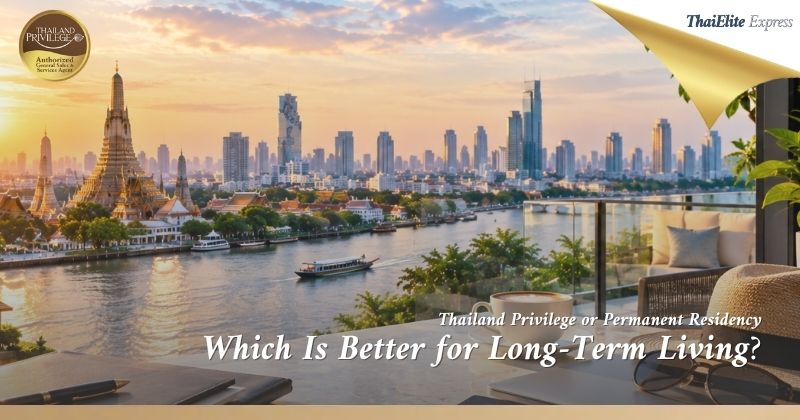
For foreigners planning to spend many years in Thailand, the choice between Thailand Privilege or permanent residency is not simply a question of which option lasts longer. These are fundamentally different immigration solutions.
Thailand Privilege is a paid membership programme designed to provide long-term access to Thailand with a streamlined stay permission process and lifestyle services. Thai permanent residency, by contrast, is an immigration status that may provide a more permanent legal connection to the country—but it involves separate eligibility rules, application procedures, quotas and government approval.
Neither option is automatically better for everyone. The right choice depends on your priorities:
This guide compares the two routes across the factors that matter most for long-term living.
Important: Thailand Privilege is not Thai permanent residency. It does not automatically lead to permanent residency, and membership approval does not guarantee that a member will qualify for or receive permanent residency in the future.
| Consideration | Thailand Privilege | Thai Permanent Residency |
| Legal nature | Paid long-stay membership with immigration benefits | Formal permanent residence status granted by the Thai government |
| Typical duration | Membership terms commonly range from 5 to 20 years, depending on the selected tier and current programme rules | Indefinite status, subject to maintaining legal requirements and avoiding loss of status |
| Application route | Membership application, background checks, approval and payment under the programme’s process | Government application submitted during the relevant application period and assessed under immigration rules |
| Approval | Subject to eligibility, screening and programme approval | Subject to eligibility, annual quota, documentation, interviews and government approval |
| Work rights | Thailand Privilege alone does not provide general permission to work | Permanent residents may still need a work permit for employment |
| Immigration administration | Designed to simplify long-term stays, but members must still follow applicable reporting and entry requirements | Permanent residents have continuing obligations, including re-entry and reporting requirements where applicable |
| Family options | Family membership arrangements may be available, depending on the programme and relationship | Each family member generally has to qualify under the applicable immigration framework |
| Best suited to | People seeking convenience, mobility and long-term access | People seeking a more permanent legal status in Thailand |
The most important distinction in the Thailand Privilege or permanent residency comparison is legal nature.
Thailand Privilege is a long-term membership programme operated through Thailand Privilege Card Co., Ltd. Members pay a membership fee in exchange for a long-stay immigration benefit and a range of associated services. Depending on the selected tier, benefits may include airport assistance, immigration support, personal assistance and lifestyle services.
The membership itself is not citizenship, permanent residency or an unrestricted work visa. It is a structured way to obtain long-term stay permission under the conditions of the programme and Thai immigration law.
The available options, fees and benefits can change. Applicants should review the current Thailand Privilege pricing and membership tiers before making a decision.
Thai permanent residency is a government-granted immigration status. It is intended for foreign nationals who meet the relevant requirements and demonstrate a qualifying connection to Thailand, such as employment, investment, family or other recognised grounds.
Permanent residency is not purchased through a membership fee. Applicants must apply under the applicable process, provide supporting evidence and receive approval from the relevant authorities.
A permanent resident generally has a stronger and more lasting legal position than a holder of a temporary stay permit or membership-based long-stay arrangement. However, obtaining permanent residency is more complex and is not guaranteed.
Thailand Privilege is issued for a defined membership period. Current membership options may provide access for terms such as 5, 10, 15 or 20 years, depending on the selected category and programme rules.
At the end of the membership term, the member does not automatically become a permanent resident. Renewal or a new immigration solution may be necessary, subject to the rules in effect at that time.
This defined duration can be an advantage for people who want a predictable long-term arrangement without committing to a permanent immigration application.
Thai permanent residency is designed to be indefinite rather than time-limited. It can offer greater long-term security, but it is not entirely unconditional.
Permanent residents must comply with applicable rules relating to travel outside Thailand, re-entry, registration and other immigration obligations. Extended absences or failure to follow the relevant procedures may create risks to the status.
The key distinction is therefore:
Thailand Privilege is generally designed to be more straightforward than a permanent residency application. The process commonly includes:
A professional service provider can help organise documents, communicate with the programme and coordinate the application process. Approval timelines vary depending on the applicant’s circumstances, nationality, documentation and screening requirements.
Permanent residency involves a separate government process. The applicant usually needs to:
The process may take considerable time and involve detailed documentary requirements. Annual quotas and nationality limits also apply under the permanent residency framework. Meeting the basic criteria does not guarantee approval.
For this reason, anyone considering permanent residency should obtain current legal advice and confirm the requirements directly with the appropriate Thai authorities before applying.
Thailand Privilege and permanent residency assess applicants in different ways.
Thailand Privilege is generally aimed at foreign nationals who want a long-term stay solution and can satisfy the programme’s screening requirements. The assessment may consider matters such as:
The focus is usually on whether the applicant can be accepted into the membership programme and pass the required checks.
Permanent residency usually requires a deeper and longer-term connection to Thailand. Depending on the category, the applicant may need to demonstrate factors such as:
The exact requirements depend on the category and the rules applicable when the application is submitted. Permanent residency should therefore be treated as a formal immigration application—not as an upgrade that follows automatically from holding another visa or membership.
Thailand Privilege is intended to reduce the administrative burden associated with long-term stays, but it does not remove all immigration obligations.
Members must still:
The practical support available through membership can make these obligations easier to manage, particularly for frequent travellers.
Permanent residents also have ongoing obligations. These may include requirements relating to reporting, registration, travel outside Thailand and re-entry. A permanent resident should not assume that indefinite status means immigration formalities no longer matter.
Frequent travel is one of the strongest reasons some people choose Thailand Privilege.
A member may live in Thailand for part of the year, leave for business or family reasons, and return without having to build an immigration strategy around repeated short-term visa applications. This can be particularly useful for:
Membership tiers with enhanced assistance may be relevant for people who value airport support and coordinated immigration services. For example, applicants comparing higher-level benefits can review the Thailand Privilege Platinum membership and Thailand Privilege Diamond membership options.
Permanent residency may provide greater status security, but it can require more careful attention to re-entry and residence-related rules. It may be more appropriate for someone who intends to establish Thailand as their primary long-term home rather than simply maintain convenient access.
Neither option should be treated as a substitute for a work permit.
Thailand Privilege generally provides long-stay immigration benefits, not unrestricted permission to work for a Thai company or operate a business in Thailand. A member who intends to work should obtain the correct visa, work permit or other authorisation for the proposed activity.
This distinction matters for entrepreneurs and executives. A person may hold Thailand Privilege while managing international affairs, attending meetings or conducting permitted activities, but the legal position depends on the nature of the work and where it is performed.
Before starting employment, signing an executive role or actively operating a Thai business, obtain advice based on the specific facts.
Permanent residency can make a person’s long-term position more stable, but it does not necessarily eliminate all employment requirements. Permanent residents may still need a work permit to work legally in Thailand, depending on the role and applicable law.
Permanent residency may, however, be attractive to entrepreneurs or professionals who intend to build a lasting economic and personal connection to Thailand and are prepared to meet the relevant criteria.
Thailand Privilege may be practical for families because eligible family members can often be included through available family membership structures, subject to programme rules and documentation. This can help a family coordinate long-term stay arrangements rather than managing separate short-term visas for each person.
Families should confirm:
Permanent residency can offer a more enduring solution for a family, but each individual’s status must be assessed under the applicable rules. A spouse or child may not automatically receive permanent residency merely because one family member is approved.
For families planning to retire or settle in Thailand, lifestyle is also important. Regional preferences vary considerably, so our guide to the best places to retire in Thailand can help with the practical side of choosing where to live.
The best immigration option is not always the one with the strongest legal status. It is the one that fits the person’s actual life.
Thailand Privilege may be more convenient for someone who wants:
Permanent residency may be more suitable for someone who wants:
Permanent residency typically requires more preparation and patience. Thailand Privilege usually requires a larger upfront financial commitment, but the process may be more predictable for applicants who prioritise convenience.
| Person or objective | Usually more suitable | Why |
| Frequent traveller | Thailand Privilege | Offers a structured long-term stay solution and may reduce the administrative burden of repeated travel |
| Retiree | Thailand Privilege or permanent residency | Thailand Privilege may be simpler and more flexible; permanent residency may suit someone establishing a permanent home |
| Entrepreneur | Depends on business activity | Thailand Privilege may support personal mobility, but separate work and business permissions may be required |
| Family | Thailand Privilege for convenience; permanent residency for long-term settlement | Membership arrangements may simplify coordination, while permanent residency offers a more lasting status if each applicant qualifies |
| Person seeking permanent status | Permanent residency | Thailand Privilege is not permanent residency and does not automatically lead to it |
| HNWI seeking convenience | Thailand Privilege | Designed for people willing to pay for long-term access, support and lifestyle services |
The answer depends on the objective.
Choose Thailand Privilege if your priority is convenience, mobility and a defined long-term stay arrangement. It may be especially suitable if you travel frequently, do not yet qualify for permanent residency, want to avoid tying your stay to a Thai employer, or value concierge support.
Consider permanent residency if your priority is a lasting legal status and a deeper settlement in Thailand. You should be prepared for a formal application, detailed supporting evidence, quotas, interviews and a potentially lengthy approval process. Even then, approval is not guaranteed.
For some people, the two options may form part of different stages of a long-term plan. However, Thailand Privilege membership should never be presented as an automatic pathway to permanent residency. Anyone considering both routes should evaluate them independently.
No. Thailand Privilege is a paid long-stay membership programme. Permanent residency is a separate immigration status granted through a government application and approval process.
A member may explore permanent residency separately if they meet the relevant requirements. Membership does not automatically create eligibility, shorten the required process or guarantee approval.
Not automatically. Thailand Privilege does not generally provide unrestricted permission to work. Employment, business operations and professional activities may require separate authorisation.
No. Applicants must satisfy the applicable requirements, submit a complete application and receive government approval. Quotas and other factors may affect the outcome.
Thailand Privilege may be more convenient for retirees who want flexibility, do not want to rely on annual retirement-visa procedures, or expect to travel regularly. Permanent residency may be preferable for a retiree who has a qualifying long-term connection to Thailand and wants a more permanent status.
Thailand Privilege may be easier to coordinate for a family seeking convenience and long-term access. Permanent residency may offer greater permanence, but each family member’s eligibility and application requirements must be reviewed.
The member must either renew or obtain another lawful basis for staying in Thailand. Membership expiry does not result in permanent residency.
The decision between Thailand Privilege or permanent residency should begin with your intended lifestyle, not just the length of stay.
If you want a practical, service-led solution that supports long-term access and frequent travel, Thailand Privilege may be the more suitable choice. If your goal is to establish a permanent legal status and build a lasting connection to Thailand, permanent residency may be worth exploring—but only through its own eligibility and approval framework.
ThaiElite Express can help you review your travel pattern, family situation, business plans and long-term goals before you choose a route. Discuss your circumstances with ThaiElite Express to identify the option that fits your plans and confirm the current requirements before applying.
For foreigners planning to spend many years in Thailand, the choice between Thailand Privilege or permanent residency is not simply...
Read MoreCan Thailand Privilege members buy property in Thailand? Learn the rules for condo ownership, land restrictions and long-term stay planning.
Read MoreThailand continues to rank among the world’s most attractive destinations for international residents, retirees, and or families
Read MoreThai Elite Express is operated by HLG (Thailand) Co., Ltd., a duly licensed General Sales Agent of the Thai Elite program and Thailand Privilege Card Co., Ltd. since 2013.