
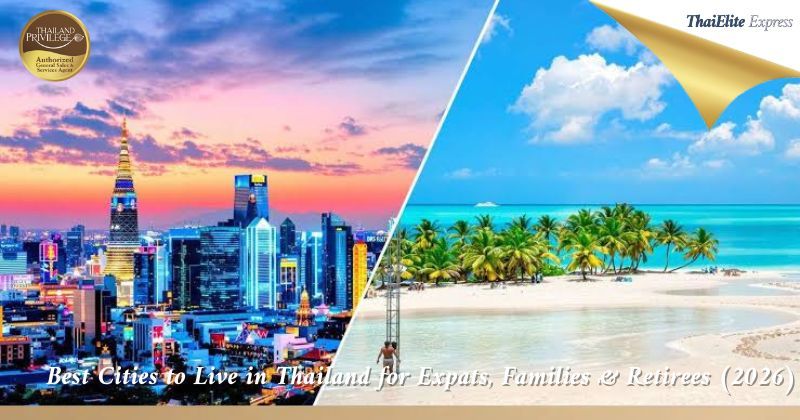
Thailand can feel like several countries in one: a global capital, mountain cities, resort coasts, and islands—each with a different pace, budget profile, and level of convenience. Below is a practical comparison of Bangkok, Phuket, Chiang Mai, Pattaya, Hua Hin, and Koh Samui across the factors that matter most to long‑stay foreigners: lifestyle, cost, internet, healthcare, schools, and communities.
“Best” depends on your priorities—so this guide is designed to help you match a city to the way you actually live. Choosing the Best Cities to Live in Thailand depends on your lifestyle, budget, career goals, and long-term residency plans.
The table below compares the Best Cities to Live in Thailand based on cost of living, healthcare, transportation, and lifestyle.
| City | Lifestyle | Cost (relative) | Internet reliability | Healthcare access | Schools | Expat communities | Best for |
| Bangkok | Global city, fast pace, endless dining & events | $$$ | High (fiber common) | High (deep specialist network) | Excellent range | Corporate expats, founders, families | Entrepreneurs, frequent travelers, families |
| Phuket | Beach + resort infrastructure, seasonal | $$$ | High in most areas (verify building) | High (strong private options) | Strong | Families, business owners, long-stayers | Beach lifestyle with services |
| Chiang Mai | Mountain city, calmer, café culture | $–$$ | High in city (verify outside core) | Medium–High | Good | Digital nomads, retirees, creatives | Value + lifestyle balance |
| Pattaya | Coastal city, varied neighborhoods | $$ | High in condos (verify) | High | Good (incl. Chonburi corridor) | Retirees, long-stayers | Coastal base with Bangkok proximity |
| Hua Hin | Quiet seaside town, relaxed routine | $$ | Medium–High (verify estates) | Medium–High | Limited but solid | Retirees, families seeking calm | Retirees, slower living |
| Koh Samui | Island living, logistics tradeoffs | $$–$$$ | Variable by area (due diligence) | Medium | Limited | Island long-stayers, families | Island base + wellness lifestyle |
Bangkok is Thailand’s hub for commerce, culture, and convenience. It’s the easiest place to live “fully international” day-to-day: top-tier restaurants, major malls, museums and galleries, embassies, and nonstop flight options. The tradeoff is obvious: more traffic, more noise, and a faster pace.
For expats, neighborhood choice is everything—your commute can define your quality of life.
Bangkok can be inexpensive or extremely expensive depending on location and housing style.
Crowdsourced averages (Numbeo, June 2026) list:
Use these as directional anchors; in practice, proximity to BTS/MRT, building age, and amenities can swing rent significantly.
Bangkok is one of the safest choices in Thailand for remote work due to widespread fiber availability and plenty of coworking and meeting spaces.
Before signing a lease, still do basic checks:
Bangkok offers Thailand’s deepest pool of private hospitals and specialists. If you have ongoing medical needs, want the broadest specialist choice, or want multiple second opinions without traveling, Bangkok is hard to beat.
(Thailand’s Ministry of Public Health lists multiple Bangkok facilities as JCI-accredited.)
Bangkok has the widest range of international schools and curricula in Thailand. Examples include:
Practical note for families: school choice and school-run commute often determines your best neighborhood.
Bangkok is where you’ll find:
Phuket blends beach living with serious infrastructure—international dining, modern gyms, wellness services, and established property options. It’s also seasonal: the vibe changes between peak tourist periods and quieter months.
A key lifestyle factor is where you live:
Phuket is often priced like an international resort market.
Numbeo (June 2026) reports:
In many residential areas, internet is strong enough for full-time remote work. Still, on islands it’s smart to:
Phuket has reputable private hospital options, including facilities listed as JCI-accredited by the Ministry of Public Health (e.g., Bangkok Hospital Phuket).
Phuket is one of the best places outside Bangkok for international schooling options, including:
Phuket attracts:
Chiang Mai is a popular long-stay base for people who want a calmer, more “daily-life” Thailand with good cafes, nature access, and a strong community feel. It’s city living—just slower and more breathable than Bangkok in day-to-day rhythm.
A practical consideration is seasonal air quality variation in Northern Thailand; if you’re sensitive, plan a trial stay across different months.
Chiang Mai tends to be more affordable than Bangkok and Phuket for comparable space.
Numbeo’s Chiang Mai dataset (July 2026) lists:
Within the city, internet is generally strong enough for professional remote work. If you rent outside central neighborhoods, confirm:
Chiang Mai has solid private hospital coverage. The Ministry of Public Health lists Chiangmai Ram Hospital as JCI-accredited.
Schools
Chiang Mai has a meaningful international school ecosystem for a regional city. Examples:
You’ll often meet:
Pattaya is more than nightlife headlines—long-stay residents often choose it for coastal convenience, a wide range of housing, and established expat services. It’s also a practical base for people who want beach access while staying connected to Bangkok’s economy.
Neighborhood choice matters a lot (some areas are far more residential and quiet than others).
Pattaya often lands between Chiang Mai and Bangkok on cost, depending on building type and proximity to the beach.
Numbeo-based reporting commonly cites:
Condo buildings commonly offer strong fixed-line options, but you should still confirm:
The Ministry of Public Health includes Bangkok Hospital Pattaya in its JCI-accredited list.
Pattaya benefits from the wider Chonburi “education corridor.” Examples include:
Pattaya is known for:
Hua Hin is often chosen for peaceful routines: beach walks, cafes, night markets, and a slower social pace. It feels more “town” than “city,” with enough infrastructure for day-to-day comfort.
Hua Hin can offer good value for a seaside location.
Numbeo (June 2026) reports:
Internet is generally workable for most remote professionals, but if you’re renting in villa/estate zones, confirm:
Healthcare access is a major reason retirees feel comfortable in Hua Hin. The Ministry of Public Health includes Bangkok Hospital Hua Hin on its JCI-accredited list, and the hospital also states JCI accreditation effective 1 March 2024.
Hua Hin has fewer international school options than Bangkok/Phuket, but there are reputable choices such as:
Hua Hin is popular with:
Koh Samui is about island rhythm: beaches, wellness, outdoor activities, and a smaller-town social fabric. It’s a strong choice if you value lifestyle over maximum convenience—but island living also means logistics (flights, shipping, specialist services range).
Samui pricing varies widely by neighborhood and proximity to the beach.
Numbeo (May 2026) reports:
Samui can be great for remote work—if you choose carefully. Do “island due diligence” before committing:
The Ministry of Public Health includes Bangkok Hospital Samui on its JCI-accredited list.
International school options exist but are more limited than in larger cities. Example:
Samui tends to attract:
Use this checklist to narrow your shortlist fast:
Many newcomers choose a city first—then realize later that their visa strategy determines how stable their life will be (renting long-term, leaving/re-entering, setting up services, etc.).
Thailand has multiple legal long-stay routes with different requirements. One popular option for eligible foreigners is the Thailand Privilege Card (formerly Thailand Elite), a membership-based long-stay program with packages ranging 5–20 years, depending on tier. Official membership fees and durations include (examples): Gold THB 900,000 (5 years), Platinum THB 1,500,000 (10 years), up to Reserve THB 5,000,000 (20 years, invitation).
Thailand Privilege also describes a general process that includes submitting documents, receiving approval (often described as within 2 months), then payment and activation steps.
Visa rules and processing practices can change. Always confirm current requirements and timelines before applying.
ThaiElite Express provides consultation and application support for the Thailand Privilege Card, and states that it is:
There is no single answer to the Best Cities to Live in Thailand because every destination offers different advantages for expats, retirees, entrepreneurs, and families. If you’re planning to move to one of the Best Cities to Live in Thailand, ThaiElite Express can help you choose the right Thailand Privilege Membership for your long-term stay.
There isn’t one best city. Bangkok is the most universally convenient, but many expats prefer Chiang Mai (pace/value) or Phuket (beach + services) depending on lifestyle.
Bangkok is typically the simplest for consistent fiber and business-grade options. That said, Thailand’s country-level internet performance is strong overall, and many expats work successfully from Phuket and Chiang Mai as well.
Many retirees choose Hua Hin for calm routines or Pattaya for convenience and established expat services. If healthcare depth is the top priority, Bangkok offers the broadest specialist ecosystem.
Bangkok has the widest range of international schools. Phuket is a leading alternative with strong options like UWC Thailand and BISP.
Bangkok is often more expensive, especially near BTS/MRT and in newer buildings. Crowdsourced rent averages suggest Chiang Mai can be notably lower for comparable central apartments.
Bangkok generally offers the broadest specialist range. Islands like Phuket and Samui still have reputable private hospitals (including JCI-listed facilities), but the depth of specialties can be narrower.
Not always, but longer leases and certain administrative tasks are often easier with stable long-stay status. Requirements vary by landlord and circumstance.
It’s a membership-based long-stay program (formerly Thailand Elite) offering multi-year stays (5–20 years by tier) plus privilege points and services. Official packages and fees are listed on Thailand Privilege’s website.
Thailand Privilege describes a process that includes receiving approval within 2 months in general terms, but timing can vary by case and screening.
Yes—many members split time across Bangkok, Chiang Mai, and beach/island bases. Your lifestyle choice is flexible; the practical issue is planning housing, travel, and healthcare access across locations.
A GSSA (General Sales and Services Agent) is an authorized representative that assists with Thailand Privilege membership sales and applicant support. ThaiElite Express explains this in its FAQ and states it is an authorized GSSA.
ThaiElite Express states it is an authorized GSSA for the Thailand Privilege Card program.
If you want the most convenience and connectivity, start with Bangkok. If you want beach living with strong infrastructure, choose Phuket. For value and a calmer pace, Chiang Mai is a classic. Pattaya and Hua Hin serve different kinds of long-stay coastal routines, while Koh Samui is ideal if island life is your priority and you’re comfortable with logistics.
Planning a long stay in Thailand? ThaiElite Express can help you compare Thailand Privilege Card tiers and guide you through the application process with an authorized GSSA team.
Thailand continues to rank among the world’s most attractive destinations for international residents, retirees, and or families
Read MoreFor eligible members holding a valid Privilege Entry Visa (PE), Thailand generally grants permission to stay for up to one...
Read MoreA Thailand Privilege membership can be valid for 5, 10, 15, or 20 years. However, that does not mean the...
Read MoreThai Elite Express is operated by HLG (Thailand) Co., Ltd., a duly licensed General Sales Agent of the Thai Elite program and Thailand Privilege Card Co., Ltd. since 2013.